
In This Article
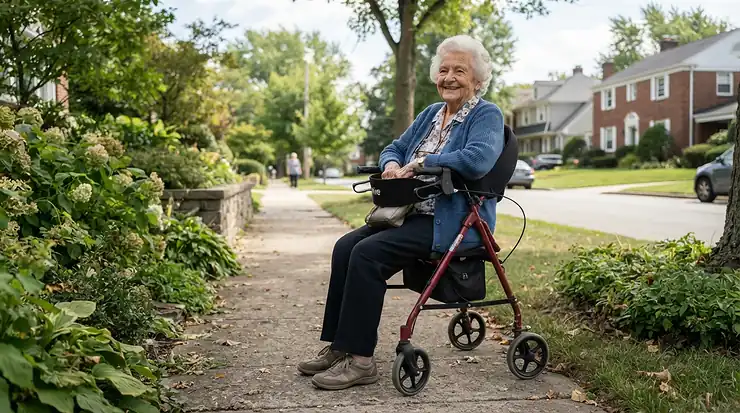
What is a rollator with seat for people with COPD? It is a four-wheeled (occasionally three-wheeled) walking frame with hand brakes and a built-in seat, chosen so that someone with chronic obstructive pulmonary disease can stop, sit and recover mid-walk instead of gripping a countertop and hoping. The best ones add a backrest, a comfortable seat height, and room to carry supplies or an oxygen cylinder.

Here’s the thing about COPD and walking: the problem is rarely your legs. It’s the moment, usually somewhere between the mailbox and the corner, when your breath runs out of road. A rollator with seat for people with COPD gives you somewhere to land. That one design feature turns “I can’t make it to the park” into “I can make it to the park, with a rest stop.”
The research backs the idea up, with honest limits. A systematic review of rollator use in COPD, covering 7 studies and 126 participants, found that walking with a rollator modestly increased six-minute walk distance and lowered end-of-test breathlessness ratings. Longer-term benefits were less clear, partly because we don’t know how consistently people actually used the device.
Translation: a rollator isn’t a miracle, but it’s a genuinely useful tool, and the specific model matters. Wheel size, seat depth, backrest shape and oxygen-carrying options all change how it feels at mile one and at mile half a mile. Below, you’ll find seven real models compared on those details, followed by guides for fitting, resting, and avoiding expensive mistakes.
Quick note: this guide is analysis based on published specifications, manufacturer information and aggregated owner sentiment, not hands-on testing. Always check your pulmonologist’s or physical therapist’s advice before choosing equipment.
Quick Comparison: 7 Rollators at a Glance
Before the deep dive, here’s the lay of the land. Prices are approximate ranges at the time of research and can change, so check current pricing before you decide.
| Rollator | Weight Capacity | Approx. Weight | Wheels | Price Range | Best For |
|---|---|---|---|---|---|
| Drive Medical Nitro (RTL10266) | 300 lb | ~17.5–18 lb | 10″ front casters | $300–$450 range | Oxygen users wanting a dedicated tank holder |
| Medline Empower | 300 lb | ~17–23 lb (varies by version) | 8″ | $130–$200 range | Best seat comfort and reversible backrest |
| Hugo Elite | 300 lb | ~17–18 lb | 8″ | $120–$190 range | Budget buyers and shorter users |
| Hugo Explore Side-Fold | 300 lb | ~15.4–15.5 lb | 8″ | $200–$300 range | Lightweight car loading |
| HOMLAND Foldable (Extra-Wide) | Check listing | ~20 lb | Check listing | Under $200 range | Larger frames needing a roomy seat |
| VOCIC Z21 | 350 lb | ~22.85 lb | 8″ all-terrain | $120–$200 range | Rougher sidewalks and higher capacity |
| Trionic Veloped | ~330 lb (150 kg) | ~27–30 lb | 12″–14″ | $900–$1,300 range | Outdoor walking and uneven ground |
Looking at the comparison above, the Drive Medical Nitro stands out for anyone who needs to carry an oxygen cylinder, because it has a purpose-made holder, though it costs more than the budget options. The Medline Empower and Hugo Elite deliver the best value if your priorities are a seat and a backrest on a tight budget. The Trionic Veloped is in a different league on price, but it solves a problem the others don’t: genuinely rough ground.
💬 Just one click — help others make better buying decisions too!😊
Top 7 Rollators With Seat for People With COPD: Expert Analysis
1. Drive Medical Nitro (RTL10266) — the one with a dedicated oxygen tank holder
The Nitro’s headline trick is an accessory many rollators simply lack: a manufacturer-made oxygen tank holder (the Drive Nitro O2 Tank Holder, item 10266-4OX) designed exclusively for this frame. If you walk with a cylinder, that matters more than almost any other spec.
The numbers behind the comfort: an 18″ wide by 10″ deep seat set at about 20.5″ off the floor, handles adjusting roughly 33.5″ to 38.25″, and a 300 lb capacity. The 10″ front casters roll over cracks and door thresholds with less fuss than 6″ wheels, which is where tired lungs notice every bump. At roughly 17.5 to 18 lb, it’s light enough to lift into most trunks. An adjustable contoured backrest, cross-brace and a side-by-side fold round out the design.
Who is it for? Anyone who needs oxygen on the move and values a clean, integrated setup. Drive also makes a tall version (handles around 36″–41″) and a heavy-duty version (rated around 450 lb), which helps if you fall outside the standard fit.
Reviewer sentiment, as best I can aggregate it, centers on the smooth rolling and the euro-style design; confirm the latest feedback on the current listing, since sentiment shifts between versions.
Pros:
- ✅ Purpose-built oxygen tank holder accessory available
- ✅ 10″ front casters roll over thresholds easily
- ✅ Tall and heavy-duty variants widen the fit
Cons:
- ❌ Costs noticeably more than budget rollators
- ❌ Tank holder is an extra purchase, Nitro-only
Price range: roughly $300–$450, plus the accessory. Strong value if oxygen is part of your daily walk.

2. Medline Empower — the plush seat with a flip-over backrest
The Empower’s defining feature is a padded backrest that flips forward or backward, so you can sit facing either direction, and a memory foam seat that sits noticeably softer than the thin vinyl pads on cheaper frames. The seat also flips up so you can step inside the frame, a small design choice with real value at a kitchen counter or bathroom sink.
On paper: 8″ wheels, a 300 lb capacity, handle heights around 31″ to 37″ (some versions reach 39.5″), and a lifetime frame warranty on some listings. Listed weights range from about 17 lb to 23 lb depending on the version and retailer, so check the exact model you’re ordering. Yellow adjustment points make the height settings easier to spot, and a folding cup holder and neoprene storage bag ship with it.
Why this suits COPD: the comfortable seat and backrest encourage you to actually stop and recover instead of pushing on. A reversible backrest also lets you face outward, which gives you an easier view of an open space and an easier sit-to-stand setup on a patio.
Reviewers on retailer pages describe it as sturdy and safe; one buyer purchased it for a 94-year-old parent in assisted living and called it rugged. That’s anecdotal, not a clinical verdict.
Pros:
- ✅ Memory foam seat encourages real recovery breaks
- ✅ Reversible padded backrest for flexible sitting
- ✅ Seat flips up for step-in support
Cons:
- ❌ Heavier than the lightest rollators in some versions
- ❌ 8″ wheels are less forgiving than 10″–12″ wheels
Price range: roughly $130–$200. Excellent comfort for the money.
3. Hugo Elite — the budget pick with a wide height range
Drive’s Hugo Elite is the value workhorse: an aluminum frame, a built-in seat with backrest, two storage options (an under-seat bag plus a saddle bag), and 8″ wheels. Handle heights run from about 29.5″ to 38″, which is unusually low at the bottom, so it can fit shorter adults that many standard rollators don’t.
Weight capacity is 300 lb, and the frame weighs around 17 to 18 lb. The seat is on the narrow side (about 14″ wide by 12″ deep), and seat height ranges from roughly 19.5″ to 22″. That’s a consideration, not a flaw: if you’re a larger frame, the seat may feel snug, and a wider model like the HOMLAND below may suit you better.
Expert take: for someone shorter, or someone who simply wants a first rollator without a major outlay, the Hugo Elite checks the essentials. The backrest is fixed in a simple way, so don’t expect fine-tuned lumbar support. But for a trip to the pharmacy with two rest stops, it does the job.
Listings on major retail sites show ratings in the mid-4-star range, though I’d treat any single star average cautiously; read the recent reviews on the exact version you’re buying.
Pros:
- ✅ Wide handle range suits shorter users
- ✅ Two storage bags included
- ✅ Light enough for most car trunks
Cons:
- ❌ Narrow seat may feel tight for larger frames
- ❌ Basic backrest with limited adjustability
Price range: roughly $120–$190. Great entry-level value.
4. Hugo Explore Side-Fold — the lightweight, easy-load option
If lifting is a worry, the Hugo Explore is the lightest on this list at about 15.4 to 15.5 lb. It folds from the side, which shrinks the profile for trunks and closets, and it locks open for added stability. The frame uses 8″ wheels, has a 300 lb capacity, a seat height of about 20″, handles from roughly 30.5″ to 37″, and an inside handle width around 17.5″.
Why that matters with COPD: loading equipment into a car can be exhausting by itself, and an exhausting loading process quietly discourages outings. Shaving even a few pounds off a rollator reduces that barrier. Spec sheets also show loop-lock brakes, which are easier to operate with arthritic hands than some cable setups.
The trade-off is that lightweight frames can feel less planted on rough ground, and you should confirm the backrest and seat dimensions on the exact listing, since lightweight side-fold designs vary in how much back support they offer.
I couldn’t verify a robust body of owner reviews specific to COPD use, so I won’t pretend otherwise. The specifications and design logic are the evidence here.
Pros:
- ✅ Lightest rollator in this lineup
- ✅ Side-fold design is compact for storage
- ✅ Locks open for added stability
Cons:
- ❌ Lighter frames feel less planted outdoors
- ❌ Backrest details need confirming per listing
Price range: roughly $200–$300. Worth it if lifting is your bottleneck.
5. HOMLAND Foldable (Extra-Wide) — the roomy seat for bigger frames
The headline here is a 16″ enlarged seat, per the product listing titles for this foldable. It’s one of the few budget rollators marketed specifically to people who find standard seats cramped. Listings place the weight around 20 lb, and it’s frequently flagged as a bestseller on aggregator sites, with ratings around the mid-4-star range.
Why it’s relevant: a seat that’s too narrow isn’t just uncomfortable, it’s less likely to be used. When recovery is the point, a wider seat makes you more willing to sit down early rather than push through breathlessness.
I’d treat the specifics here carefully. Weight capacity, wheel size and handle ranges vary between HOMLAND versions, and the spec sheets I reviewed weren’t consistent, so confirm all three before you buy. The roomier seat also usually means a wider overall frame, so measure your doorways and hallways, especially in older homes.
Pros:
- ✅ Enlarged seat suits broader frames
- ✅ Foldable for transport and storage
- ✅ Affordable compared with premium brands
Cons:
- ❌ Wider frame is harder in tight hallways
- ❌ Specs vary by version, so verify carefully
Price range: roughly under $200. Good value if seat width is your priority.

6. VOCIC Z21 — the all-terrain pick with higher capacity
The VOCIC Z21 offers 8″ all-terrain wheels, a 350 lb capacity, dual height adjustment and a weight around 22.85 lb. That higher capacity gives some breathing room, literally, if you also carry an oxygen cylinder, bag and groceries.
All-terrain wheels matter more than they sound. Patchy sidewalks, gravel paths and grass parks create resistance, and resistance makes breathing harder. A slightly more rugged wheel helps in those moments. Aggregator sites rate it around 4.5 to 4.6, and one highlights tire durability on rough surfaces, though I’d treat those as editorial impressions rather than clinical evidence.
The cost of that sturdiness is weight: at nearly 23 lb, it’s heavier than the Hugo options. If you load the rollator into your own car, try lifting one in a store first.
Pros:
- ✅ 350 lb capacity adds safety margin
- ✅ All-terrain wheels handle uneven paths
- ✅ Dual height adjustment for fit
Cons:
- ❌ Heavier to lift than lightweight rivals
- ❌ Less proven brand history than Drive or Medline
Price range: roughly $120–$200. A smart choice for rough routes.
7. Trionic Veloped — the premium option for rough ground
The Veloped is the oddball: a Swedish-designed, three-wheel-looking walker (it has four wheels, with a dual front wheel) built mainly for outdoor use. Its 12″ or 14″ wheels and a patented climbing wheel can overcome obstacles up to roughly 13 to 15 cm (about 5 to 6 inches) without lifting the frame. Max user weight is about 150 kg (330 lb), and it’s tested to an ISO standard for walking aids.
The seat doubles as the support, and Trionic sells a backrest padding accessory that fits on the grip bar. A removable, washable basket holds roughly 22 to 35 liters depending on the model.
Real-world COPD relevance: one Trionic reviewer described living with COPD, knee surgeries and balance problems, and said a normal walker was impossible in a large garden with no paved paths, while the Veloped made that walking possible. That’s a single testimonial, not evidence, but it matches the design logic: big wheels mean less effort over rough ground.
One important flag: I could not verify an oxygen tank holder for the Veloped in the accessory lists I reviewed. If you use oxygen, ask Trionic or a dealer before buying. It is also heavier than a typical rollator at roughly 27 to 30 lb.
Pros:
- ✅ Big wheels roll over curbs and roots
- ✅ Washable removable basket with generous capacity
- ✅ Excellent outdoor stability
Cons:
- ❌ Premium price puts it out of reach for many
- ❌ Oxygen holder compatibility unconfirmed
Price range: roughly $900–$1,300. Justified only if you truly walk outdoors on rough terrain.
Here’s how those seven stack up on the details that decide COPD comfort.
| Rollator | Seat Size | Seat Height | Backrest | O2 Holder | Value Verdict |
|---|---|---|---|---|---|
| Drive Medical Nitro | 18″ × 10″ | ~20.5″ | Adjustable contoured | Yes, Nitro-specific accessory | Strong if you use oxygen |
| Medline Empower | ~16–17.5″ wide, memory foam | ~20.5″ | Reversible padded | Not verified | Best comfort per dollar |
| Hugo Elite | ~14″ × 12″ | ~19.5–22″ | Yes, basic | Not verified | Best budget entry |
| Hugo Explore | ~17.5″ inside width | ~20″ | Confirm per listing | Not verified | Best for lifting |
| HOMLAND Foldable | ~16″ (per listing) | Check listing | Check listing | Not verified | Best for wider frames |
| VOCIC Z21 | Check listing | Check listing | Check listing | Not verified | Best for rough routes |
| Trionic Veloped | ~17.3″ wide | ~22.8″ | Optional padding | Not confirmed | Premium outdoor option |
Read that table with one rule in mind: the “not verified” cells aren’t dealbreakers, but they’re homework. If an oxygen tank holder is non-negotiable, the Drive Medical Nitro is the only model here with a confirmed purpose-made accessory. For everyone else, the Medline Empower offers the best mix of seat comfort and price, and the Hugo Elite is the cheapest way to get a seat and backrest into your life.
✨ Don’t Miss These Exclusive Deals!
🔍 Take your daily walks to the next level with these carefully selected rollators. Click on any highlighted item to check current pricing and availability. A rollator with the right seat and backrest can help you build confident, independent routines your whole family will notice!
Setup and First-30-Days Guide
Buying the rollator is the easy part. Fitting it is where comfort and safety are won or lost, and the first month is when habits form.
Step 1: Set the handle height. Stand tall inside the frame with your arms relaxed at your sides. The handgrips should line up with the crease of your wrist, a standard fitting rule shown in Duke’s walker adjustment tip sheet. Too low and you hunch, which squeezes your chest; too high and your shoulders hike up and tire quickly.
Step 2: Check the seat. Sit down with the brakes locked. Your feet should rest flat, and standing back up shouldn’t feel like a gymnastics event.
Step 3: Test the brakes before you test the route. Practice locking and releasing them in your living room. Never sit on a rollator with the brakes unlocked, ever.
Step 4: Map your first walks. Start with short routes where you know there’s a bench or shaded spot. Your goal in week one isn’t distance; it’s learning how your breathing responds.
Step 5: Build a rest rhythm. Rather than waiting until you’re desperate, many people find it helpful to sit before the breathlessness peaks. Ask your pulmonary rehab team what pace and rest schedule suits your condition.
Common mistakes in the first 30 days: loading too much weight on the hand grips, leaving the backrest too high or too low, walking too far from the rollator, and skipping weekly checks of brakes, wheels and bolts. A two-minute weekly inspection (squeeze brakes, spin each wheel, wiggle the folding hinge) catches problems before they become falls.
Pursed Lip Breathing Rest: Turning Your Seat Into a Recovery Station
A seat only helps if you know what to do once you’re on it. This is where pursed lip breathing rest comes in, a pairing that pulmonary rehab clinicians often teach.
The American Lung Association describes pursed lip breathing as a way to slow the pace of breathing and make each breath more effective. The basic pattern: sit with your neck and shoulders relaxed, breathe in slowly through your nose, then exhale gently through lips shaped as if you were whistling or blowing out a candle, taking roughly twice as long to breathe out as you did to breathe in.
Why a rollator seat is the perfect partner: you need a stable, brake-locked seat before you can relax your shoulders and focus on your exhale. Standing and leaning on the frame works in a pinch, but sitting lets your diaphragm and neck muscles ease off.
Here’s a simple routine for your next outing:
- Lock both brakes.
- Sit and lean lightly against the backrest.
- Drop your shoulders; rest your hands on your thighs.
- Inhale through your nose for a count of two.
- Exhale through pursed lips for a count of four or more.
- Repeat until your breathing settles.
The ALA also advises practicing these techniques regularly when you feel well, not just in a crisis, so they feel automatic when you need them. And if your breathing doesn’t return to normal after a few minutes of resting, that’s a signal to seek urgent medical attention, not to push on.
Treat this section as general education, not a prescription. Your care team can tailor the pattern to your lungs.
Real-World Scenarios: Three COPD Walking Profiles
Spec sheets can’t tell you how a rollator fits your life, so here are three illustrative profiles (composite scenarios, not real individuals) matched to the best choice with reasoning.
Scenario 1: The oxygen user running errands. Picture someone on portable oxygen, shopping twice a week, walking two or three blocks to the pharmacy and market. Budget is flexible, and the cylinder is the headline problem. Here the Drive Medical Nitro is the logical match, because the tank rides on the frame instead of in a shoulder bag, and its 10″ front casters handle curb cuts. The accessory adds cost, but removing the weight from the body is the point.
Scenario 2: The budget-conscious retiree. Imagine a person with moderate COPD walking mostly indoors and around a flat block, with limited funds. The Hugo Elite or Medline Empower fits well. If they’re shorter, the Hugo Elite’s low handle range helps. If comfort is the priority, the Empower’s memory foam seat and reversible backrest win.
Scenario 3: The weekend park walker. Think of someone who loves gravel paths, grass and uneven trails, and walks 20 to 30 minutes at a time. The VOCIC Z21 offers a cost-effective all-terrain option, while the Trionic Veloped is the premium pick if rough ground is a regular occurrence and the budget stretches.
The pattern: match the rollator to the terrain, your oxygen situation, and your body size first, then to price. A useful reality check from research: in a small study of people with COPD who had been given rollators, about 59 percent reported using them daily, and use was more common outdoors than indoors. A rollator that suits your routes is one you’ll actually use.
How to Choose a Rollator With Seat for Shortness of Breath
If your main complaint is breathlessness, these seven steps will keep you out of trouble. Each one comes with the reasoning behind it.
- Start with your routes, not the product. List where you walk: smooth indoor floors, sidewalks, parks. Terrain decides wheel size.
- Match wheel size to terrain. Larger wheels (10″ to 14″) roll over obstacles with less effort; 6″ wheels suit smooth indoor floors but struggle outdoors.
- Confirm weight capacity with margin. Add your body weight, any oxygen cylinder, and what you carry. Buy a capacity comfortably above that total.
- Check seat width, depth and height. A seat around 18″ wide suits many adults; a seat that’s too narrow or too high makes you avoid using it.
- Insist on a real backrest. Look for padded, adjustable support, as covered below.
- Check weight and fold for your car. A rollator you can’t lift is a rollator you’ll leave at home.
- Plan for oxygen early. If you use a cylinder, confirm a compatible holder before you buy, not after.
Research gives helpful context here. In one randomized crossover study of people with severe COPD, using a rollator reduced breathlessness and the duration of rests during a six-minute walk, and the people who benefited most were those who walked less than 300 m unaided and needed to rest during the test. In plain English: if you already stop to catch your breath often, you’re the person most likely to benefit.
Rest Stop Walker With Seat for Lung Disease: Planning Your Route
Think of a rest stop walker with seat for lung disease as a mobile bench. The real skill isn’t just having the seat; it’s planning your day around it so you rest before you crash.
Plan outings in segments. Break a walk into short legs with deliberate pauses. A 10-minute walk with two planned sits usually feels easier than a 10-minute walk where you push until you’re gasping. The physiological finding behind this is interesting: studies suggest the rollator reduces breathlessness even though the metabolic cost of walking doesn’t always change, so the benefit is partly about posture and support, not just energy savings.
Choose smooth, shaded routes first. Ramps, curb cuts and benches make the early weeks easier. Save hills and uneven paths for later.
Respect weather and air quality. Heat, cold, humidity and poor air quality can all make breathing harder. On bad days, indoor walking laps may be the better choice.
Carry a short checklist. Water, medications your doctor has recommended, a phone, and your oxygen supplies if relevant. A rollator’s storage bag makes this easy.
Use the seat early, not late. Many people wait until they’re desperate, which makes recovery slower. Sit when you first feel your breathing climbing, and combine it with the breathing techniques above.
Oxygen Tank Holder: What to Know Before You Buy
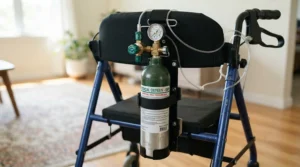
An oxygen tank holder transforms a rollator from a seat on wheels into a mobile breathing station, but this is the area where assumptions cause the most trouble.
Holders are often brand-specific. The Drive Nitro O2 Tank Holder, for instance, is made exclusively for the Nitro rollator, according to retailer listings. A universal accessory may exist for other frames, but fit varies, so measure your cylinder and read the compatibility notes.
Tank size matters. Smaller portable cylinders fit most holders; larger ones may not. Ask your oxygen supplier for your cylinder’s dimensions and weight before shopping.
Respect weight limits. Your rollator’s capacity must cover you, the cylinder, and everything you carry. Also consider balance: a loaded holder changes how the frame feels when you lean on it.
Secure the cylinder. A tank that can tip or slide is a hazard. Always follow the rollator and oxygen supplier’s instructions, and ask your respiratory therapist to show you how to load and strap it.
Traveling by air is a separate topic. If you use a portable oxygen concentrator, it generally must meet FAA requirements and carry the right labeling. The FAA’s advisory circular on portable oxygen use summarizes safety and enforcement policy, and airlines add their own procedures, so contact your carrier well ahead of time and bring enough batteries for delays.
The honest limitation: most rollators on the market don’t include a verified oxygen holder. If that accessory matters, make it the first filter in your search, not the last.

Backrest Support: Why It Matters for Breathing Posture
Backrest support is the feature people underestimate until they’re sitting down tired. In COPD, posture and breathing are tightly connected: slumping compresses the chest and makes every inhale feel like work, while a supported, slightly upright position lets your shoulders drop and your breathing muscles relax.
What to look for:
- Height-adjustable backrest. The Drive Medical Nitro offers an adjustable contoured backrest, which lets you position support closer to your mid-back.
- Padded, comfortable material. The Medline Empower uses a padded backrest with a memory foam seat, and it flips so you can face either direction.
- Stable attachment. A wobbly backrest undermines confidence. Press on it before relying on it.
- Width that matches your torso. A strap-style backrest that’s too narrow gives support in only one spot.
Don’t expect orthopedic lumbar support from any standard rollator. What you’re getting is a stable place to lean while you recover. If you need more, accessories like add-on padding exist for some frames (Trionic sells backrest padding for the Trionic Veloped, for example).
A practical test: sit for two full minutes with the brakes locked. If your shoulders creep up or your lower back starts to complain, adjust the backrest height or try a different model.
Features That Actually Matter (And Those That Don’t)
Marketing pages are loud. Here’s the filter.
Features that matter:
- Hand brakes you can operate easily. Loop-lock brakes are friendly for weak or arthritic hands; check the feel in person if you can.
- A seat and backrest you’ll actually use. Comfort drives usage, and usage drives the benefit.
- Appropriate wheel size. Match it to terrain, as above.
- Weight and fold. Match it to how you transport the rollator.
- Accurate fit. Handle height range and seat height should suit your body.
Features that matter less than advertised:
- Color options. Pretty is nice, but it won’t improve your breathing.
- Extra cup holders and gadgets. Handy, rarely decisive.
- Superlative claims. “Best overall” badges on aggregator sites often reflect affiliate incentives, so lean on specifications and the safety rules above.
- Extreme lightness at the expense of stability. A very light frame can feel flimsy outdoors.
The best filter is a question: “Will this feature make me more likely to walk and to rest safely?” If not, skip it.
Rollator vs Standard Walker vs Cane: Which Is Right for COPD?
A rollator isn’t automatically the right answer. Here’s an honest comparison.
A standard two-wheeled or fixed walker is stable and inexpensive, but it has no seat and requires lifting or sliding with each step, which can be tiring when you’re short of breath. A cane is lightweight but offers little support and no seat. A rollator rolls continuously, which creates a smoother rhythm, and its seat provides built-in rest, though it does demand some coordination and brake discipline. Wheelchairs and transport chairs are best for longer distances when someone else pushes, but they don’t encourage walking.
| Option | Seat for Rest | Continuous Walking Rhythm | Stability | Best For |
|---|---|---|---|---|
| Rollator (e.g., Medline Empower) | Yes | Yes | Good with brakes | People who need frequent rest breaks |
| Standard walker | No | No (lift-and-place) | Very high | Severe balance issues, short distances |
| Cane | No | Yes | Low | Mild support only |
| Transport chair | Yes (passenger) | N/A | High | Longer outings with a helper |
Reading that table: the rollator fills a niche the others don’t, since it’s the only option that combines continuous walking with a seat you control. For COPD specifically, the research concluded that short-term rollator use modestly improved walking distance and reduced breathlessness. That doesn’t mean everyone should switch; people with significant balance or grip problems may do better with a more stable frame, and a physical therapist can help you decide.
Common Mistakes When Buying a Rollator for COPD
Smart people make these errors all the time.
Choosing by price alone. A very cheap rollator with a hard seat, weak brakes or 6″ wheels might sit unused. The real cost is the money spent on something you don’t use.
Ignoring height. An ill-fitting frame forces poor posture. Check the handle range against your height before ordering.
Forgetting oxygen from the start. Retrofitting a holder is often impossible. Decide first.
Overlooking weight capacity. Add the cylinder and your gear to your body weight.
Skipping the trial. If you can, sit in the rollator and test the brakes in a store or at a clinic. Your pulmonary rehab team or a medical supply store may let you try models.
Buying for the “someday” version of yourself. Choose for the walks you actually take now, with a little room to grow, rather than a heavy outdoor machine for imagined hikes.
Treating the rollator like a wheelchair. Never ride it, and never sit with the brakes unlocked. Rollators are walking aids first.
Long-Term Cost and Maintenance
Cheap upfront doesn’t always mean cheap over years. Here’s how to think about total cost of ownership.
Purchase price versus use. A rollator in the $120–$200 range used daily for several years costs pennies per walk. A premium option like the Trionic Veloped (roughly $900–$1,300 range) only pays off if its outdoor capability changes how much you walk.
Accessories add up. An oxygen tank holder, cup holder, extra bags or a cane holder can add meaningfully to the cost. Budget for the ones you’ll truly use.
Maintenance schedule:
- Weekly: squeeze the brakes, check tire condition, wipe handles.
- Monthly: tighten visible bolts, check folding locks, inspect the seat.
- Every few months: clean wheel bearings and axles of hair and debris.
- As needed: replace worn brake pads, tires or grips; check the manufacturer’s warranty. Drive lists limited-lifetime coverage on some Nitro frames with shorter coverage on brake and handle housings, and Medline lists lifetime frame coverage on some Empower listings, but terms vary by retailer and version.
Replacement timing. If brakes feel mushy, the frame wobbles, or the seat sags, don’t wait. A rollator is safety equipment.
Insurance coverage for rollators varies, so ask your doctor and insurer rather than assuming. A prescription from your care team can sometimes help.

Frequently Asked Questions
❓ Can I use an oxygen tank holder with any rollator?
❓ What seat height is best for COPD rollator users?
❓ Is a rollator with backrest support worth extra money?
❓ How do I know if my rollator is the right height?
❓ How much weight capacity do I need if I carry oxygen?
Conclusion
A rollator with seat for people with COPD won’t cure breathlessness, but it can change the shape of a day. It turns “I can’t go that far” into “I can go that far if I plan the rest stops.” The research suggests short-term improvements in walking distance and breathlessness, and the design logic is simple: a stable seat gives you somewhere to use pursed lip breathing and recover before you hit the wall.
Here’s the shortcut. If you use oxygen, start with the Drive Medical Nitro and its dedicated tank holder. If comfort and value matter most, the Medline Empower is hard to beat. If budget and a lower handle range are priorities, the Hugo Elite earns its place. If lifting is your barrier, look at the Hugo Explore Side-Fold. If you need a roomier seat, the HOMLAND Foldable fits that gap. If your routes are rough, the VOCIC Z21 or the premium Trionic Veloped handle the terrain.
Whichever you choose, fit it properly, test the brakes, and loop in your pulmonary rehab team or physical therapist. Equipment works best when it’s matched to your lungs, your routes and your life.
✨ Ready to take the next step? 🔍 Compare the models above, check current pricing and availability, and pick the rollator that gives you the confidence to keep walking. Your next rest stop is waiting! 💬
Recommended for You
- [Add your blog post link 1]
- [Add your blog post link 2]
- [Add your blog post link 3]
Disclaimer: This article contains affiliate links. As an Amazon Associate, I earn from qualifying purchases. If you purchase products through these links, we may earn a small commission at no additional cost to you.
✨ Found this helpful? Share it with your friends! 💬🤗
