
In This Article
What is a 3 wheel rollator for small apartments? It is a wheeled walking aid with one swiveling front wheel, two rear wheels, hand brakes and a frame narrow enough to turn inside kitchens, hallways and bathrooms where a four-wheel model would clip cabinets. It trades some stability for tighter turning, so it suits users who need light-to-moderate support.

Now picture the typical one-bedroom. A galley kitchen. A bathroom door that opens right into the toilet. A hallway about as roomy as a bowling lane. In a space like that, a wide four-wheel rollator becomes a game of Tetris you lose daily. That is the real reason people shop for a 3 wheel rollator for small apartments: the walker should fit the home, not the other way around.
Here is the catch, and I’ll be upfront about it. Walking aids are not magic. Researchers studying walking-aid stability point out that walking-aid use has been linked to increased fall risk, which is why fit, brakes and habits matter as much as the product. A three-wheeler gives up some of the stability a fourth wheel provides, and that stability tradeoff is the thread running through this entire guide.
I built this article from real product specs, real retailer and roundup data, and aggregated review themes. I have not tested these products myself, and I won’t pretend otherwise. What you’ll get instead is honest analysis: seven real models, what their specs mean in a 600-square-foot apartment, and a clear read on who each one suits. This is general information, not medical advice. A doctor or physical therapist should confirm that a rollator is right for you.
Quick Comparison Table: 7 Picks at a Glance
| Product | Standout Trait | Best For |
|---|---|---|
| Vive Mobility 3 Wheel Walker | Narrow, cross-braced frame | Narrow hallways and car trips |
| PLANETWALK Premium 3 Wheel Rollator | Self-locking fold, large review base | Everyday value seekers |
| HOMLAND Foldable 3 Wheel Walker | Cup and cane holders | Accessory-minded users |
| Carex 3 Wheel Walker | Large pocketed storage bag | Carrying groceries and meds |
| Drive Medical Nitro Euro Style 3 Wheel Rollator | Premium-brand styling | Style-conscious, steady walkers |
| Medline 3-Wheel Steel Rollator | Steel frame, seat and tray | Budget buyers wanting a seat |
| Helavo 3 Wheel Walker with Double Front Wheels | Dual front wheels | Users wanting a wider front footprint |
Looking at the table, the Vive Mobility 3 Wheel Walker and Carex 3 Wheel Walker lean toward pure apartment practicality, while the Medline 3-Wheel Steel Rollator is the only one on this list marketed with a padded seat. If you worry about balance, the Helavo 3 Wheel Walker with Double Front Wheels is the one to look at closely. Its front end is designed to spread the load wider than a single caster.
💬 Just one click — help others make better buying decisions too!😊
Top 7 3 Wheel Rollators for Small Apartments: Expert Analysis
A quick honesty note before the list. Ratings below are snapshots from retailer listings and third-party roundup sites at the time of research, and they drift. I could not verify individual review text for every model, so I describe patterns rather than quote anyone. Prices are ranges only; check current price before buying.
1. Vive Mobility 3 Wheel Walker — narrowest-feeling frame with a lifetime guarantee
The headline here is the slim, cross-braced frame, which matters if your hallway doubles as a coat closet.
Listings put the frame at roughly 11 lb, with height-adjustable handles, a removable storage bag, a car-friendly fold and a lifetime guarantee. That 11 lb figure means you can lift it over a threshold or into a trunk without a grunt. The trade is that very light frames can feel less planted, especially on thick rugs.
Based on the spec comparison, this suits a steady walker who needs something to touch and steer with more than something to lean on. The cross-brace is the right feature to notice: it stiffens the frame, which partly offsets the missing fourth wheel.
Roundup sites commonly list it around the mid-4-star mark and repeatedly feature it for narrow spaces. Treat that as aggregated sentiment, not gospel.
Pros:
- ✅ Slim frame suits narrow hallways
- ✅ Light enough to lift and fold easily
- ✅ Lifetime guarantee adds long-term confidence
Cons:
- ❌ No built-in seat in the listed highlights
- ❌ Capacity rating worth verifying before purchase
Price: not verified at research time; aluminum three-wheelers in this class commonly run roughly $70-$130. Good value if narrowness is your top priority.

2. PLANETWALK Premium 3 Wheel Rollator — self-locking fold with the biggest review base
Its hook is a self-locking fold, a small detail that saves fumbling when you stow it beside the fridge.
Listed specs include an ultra-light aluminum frame near 11 lb, a 260 lb capacity, 8-inch wheels, ergonomic handles and height adjustment. Eight-inch wheels roll over door thresholds and cracked sidewalks better than 6-inch casters, which is a real advantage when your building has uneven elevator lips. The 260 lb ceiling is lower than some competitors, so heavier users should look elsewhere.
On paper this is the “sensible default” of the group. It doesn’t chase gimmicks. It’s for someone who wants a light, well-reviewed frame without accessories they’ll never use.
One roundup shows an average near 4.5 across a couple thousand ratings, and reviewers commonly praise the light handling. Because that comes from a secondary source, verify on the live listing.
Pros:
- ✅ Self-locking fold simplifies storage
- ✅ 8-inch wheels handle thresholds better
- ✅ Light aluminum frame near 11 lb
Cons:
- ❌ 260 lb capacity rules out heavier users
- ❌ Accessories are minimal compared with rivals
Price: not verified; expect roughly $70-$130 for this class. Strong value for the review volume.
3. HOMLAND Foldable 3 Wheel Walker — cane and cup holders built in
The standout is the accessory bundle: a cup holder and a cane holder.
It lists about 10.4 lb, 8-inch wheels, a two-side folding design and a one-year warranty. The cane holder is more useful than it sounds. If you alternate between a cane for short trips and a rollator at home, you won’t be juggling both. The two-side fold should shrink the footprint when parked in a closet.
What the spec sheet won’t tell you is how fussy accessory mounts become on a narrow frame. Anything hanging off the sides adds width exactly where you’re trying to save it, so check where those holders sit.
A roundup lists it around 4.4 across roughly 650 ratings, with the light weight as a recurring positive. The one-year warranty is notably shorter than Vive Mobility 3 Wheel Walker‘s lifetime coverage.
Pros:
- ✅ Cane and cup holders reduce juggling
- ✅ Lightest listed weight near 10.4 lb
- ✅ 8-inch wheels roll smoothly
Cons:
- ❌ One-year warranty is short
- ❌ Accessories may add width
Price: not verified; roughly $70-$130 is typical for the class. Fair value if you’ll use the holders.
4. Carex 3 Wheel Walker — large pocketed storage bag
Storage is the pitch: a large bag with pockets, which matters in an apartment without a pantry nearby.
Specs highlight 7-inch locking wheels, height-adjustable handles and quick tool-free assembly. Seven-inch wheels are slightly smaller than the 8-inch crowd, so thresholds will feel a bit bumpier. In return you get compact proportions, and “locking” wheels give extra confidence when you pause at the counter.
This is for someone who carries medication, a phone, glasses and a few groceries in one trip. Think of the bag as a purse on wheels, but keep heavy items low and centered so the load doesn’t pull the front wheel around.
One roundup named it an editor’s choice for narrow spaces. I couldn’t verify detailed rating counts, so I won’t claim any.
Pros:
- ✅ Large bag with multiple pockets
- ✅ Tool-free assembly saves time
- ✅ Locking wheels help when parked
Cons:
- ❌ 7-inch wheels feel rougher on thresholds
- ❌ Review volume not verified
Price: not verified; roughly $70-$130 for similar frames. Good value for storage-first buyers.
5. Drive Medical Nitro Euro Style 3 Wheel Rollator — premium-brand look with tight turning
The hook is brand heritage and a sleeker “Euro-style” look, which some users prefer over a clinical appearance.
The listing is model RTL10266TWHL, and retailers show it with a basket and a limited lifetime warranty. One review summary notes internal cable routing that cuts down on tangling and a compact three-wheel layout for tight spaces. The same summary raises real concerns: a freely swiveling front wheel that can feel unstable for people with balance issues, weak plastic brakes, and a stiff folding latch.
My read: this is for a steady, confident walker who values looks and turning radius over braking power. If balance is a worry, the reviewer’s caution counts for a lot.
A major retailer shows around 4.4 stars across a small pool of reviews, so the sample is thin.
Pros:
- ✅ Compact layout turns tightly
- ✅ Internal cabling reduces tangling
- ✅ Limited lifetime warranty
Cons:
- ❌ Brakes described as weak
- ❌ Free-swiveling front wheel may feel unsteady
Price: roughly $190-$255 range at retailers at the time of research. Pricey for the stability concerns raised.

6. Medline 3-Wheel Steel Rollator — budget steel frame with a padded seat
This is the budget pick with the most “furniture” included: a seat, a basket, a tray and a storage bag.
Listings describe a steel frame, two hand brakes, 8-inch wheels, a height range around 32-35 inches and a 275 lb capacity. Steel adds heft and durability, but it’s heavier than the aluminum models above, so it’s less ideal if you lift it often. The tray is the sleeper feature: carrying a mug from kettle to table is a daily apartment chore, and a tray makes it safer.
The honest take: this is for someone who wants a simple, sturdy frame with a quick rest option. Use the seat only with the brakes locked, a point we’ll revisit in the safety section below.
Retailer listings show roughly four stars on at least one page, and I couldn’t verify a deep review pool.
Pros:
- ✅ Seat, tray and basket included
- ✅ Sturdy steel frame
- ✅ 275 lb listed capacity
Cons:
- ❌ Heavier than aluminum rivals
- ❌ Fewer verified reviews
Price: roughly $75-$115 range at retailers. Excellent value for features per dollar.
7. Helavo 3 Wheel Walker with Double Front Wheels — dual front wheels for a wider footprint
The standout is a dual-wheel front end, which directly attacks the biggest weakness of three-wheelers.
Listings describe 300 lb capacity at about 12.1 lb. A single front caster is the part that makes three-wheelers nimble but twitchy. Doubling up the front wheels, as the listing describes it, should widen the contact patch and calm the pivot. The price you pay is a slightly less tight turn, since two wheels resist spinning on a dime.
That makes it a thoughtful compromise: more steady than a single-caster design, still far narrower than a four-wheel rollator. I could not verify rating figures, so check recent buyer feedback.
Pros:
- ✅ Dual front wheels improve steadiness
- ✅ 300 lb listed capacity
- ✅ Light frame near 12.1 lb
Cons:
- ❌ Slightly wider turning arc than single-caster designs
- ❌ Review volume not verified
Price: not verified; roughly $70-$140 is typical for the class. Good value for stability-minded buyers.
Specs, Price Ranges and Review Snapshot
| Product | Listed Weight | Listed Capacity | Price Range | Review Snapshot | Best For |
|---|---|---|---|---|---|
| Vive Mobility 3 Wheel Walker | ~11 lb | Verify listing | ~$70-$130 | Mid-4-star in roundups | Narrow halls |
| PLANETWALK Premium 3 Wheel Rollator | ~11 lb | 260 lb | ~$70-$130 | ~4.5 (roundup) | Everyday value |
| HOMLAND Foldable 3 Wheel Walker | ~10.4 lb | Verify listing | ~$70-$130 | ~4.4 (roundup) | Accessories |
| Carex 3 Wheel Walker | Verify listing | Verify listing | ~$70-$130 | Not verified | Storage |
| Drive Medical Nitro Euro Style 3 Wheel Rollator | Verify listing | Verify listing | ~$190-$255 | ~4.4 (small sample) | Style |
| Medline 3-Wheel Steel Rollator | Verify listing | 275 lb | ~$75-$115 | ~4.0 (one listing) | Seat and budget |
| Helavo 3 Wheel Walker with Double Front Wheels | ~12.1 lb | 300 lb | ~$70-$140 | Not verified | Steadier front end |
The table makes one pattern obvious: the Drive Medical Nitro Euro Style 3 Wheel Rollator costs roughly double its peers while its own reviewers flag brakes and stability. The Medline 3-Wheel Steel Rollator delivers the most features per dollar, with the weight penalty of steel. Where “Verify listing” appears, I could not confirm the number from my research, and you should check it before buying.
✨ Don’t Miss These Exclusive Deals!
🔍 Take your search for a 3 wheel rollator for small apartments to the next level with these carefully selected products. Click on any highlighted item to check current pricing and availability, then measure your doorways before you commit. These picks will help you move through your home with confidence!
Front Wheel Pivot and Maneuverability: How Three Wheels Turn Corners
Maneuverability is the reason this category exists, so let’s look under the hood. On a typical tri-walker, one front caster swivels freely while the two rear wheels stay fixed. That front wheel pivot lets the frame rotate around you rather than swinging wide, and the result is a noticeably smaller turning circle than a four-wheel rollator, which has to arc through corners.
Why does that matter in an apartment? Because small spaces are made of 90-degree turns. A bathroom doorway, a kitchen corner, a bedroom nook: each one is a pivot problem. Several sources describing three-wheel designs note the tighter turning radius as their defining advantage, and one retail guide notes that four-wheel models are bulkier and harder to turn indoors.
There’s a flip side, though. A free-pivoting front wheel is also the part that can “flutter” or drift if you push off-center. That’s exactly what one reviewer of the Drive Medical Nitro Euro Style 3 Wheel Rollator described as a stability concern. The Helavo 3 Wheel Walker with Double Front Wheels tries to fix this with a twin-wheel front, trading a bit of turning agility for calm tracking.
A practical test: when you shop, ask how the front wheel behaves when you let go of one handle for a second. A well-damped pivot keeps its heading. A twitchy one wanders. And remember that maneuverability isn’t only the frame; it’s also you. Short, deliberate steering inputs beat big sweeping ones in any tight space.
The Stability Tradeoff: What You Give Up for Three Wheels
Every three-wheeler asks you to accept a stability tradeoff, and pretending otherwise would be a disservice. Four wheels create a rectangular base. Three wheels create a triangle, and a triangle has less room before it tips, particularly toward the corners.
Consumer guides consistently describe three-wheelers as best for slight to moderate support needs, steadier indoors than on rough outdoor ground. One retailer explainer put it bluntly: thick shag rugs and gravel are where three-wheelers struggle, while tile, hardwood and thin carpet are their comfort zone. That’s useful for apartment dwellers, since most apartments are hard floors and thin carpet anyway.
The research on fall mechanisms adds nuance. One study of older adults in long-term care found that two-wheeled walker users most often fell sideways while turning, and rollator users most often fell backward during weight transfer. That study covered two-wheeled walkers and four-wheel rollators, not tri-walkers specifically, so don’t over-apply it. Still, the lesson carries: turning and getting up are the risky moments, and a nimble walker that turns easily can also tempt you to turn fast.
So how do you manage the tradeoff? Choose a frame with a cross-brace, consider dual front wheels, keep loads low in the bag, and ask a clinician whether you need more support than a three-wheeler offers. If you do lean heavily on your walker, a four-wheel or standard walker may be the safer call, even if it costs you hallway space.
3 Wheel Rollator vs 4 Wheel Rollator vs Standard Walker
| Feature | 3 Wheel Rollator | 4 Wheel Rollator | Standard Walker |
|---|---|---|---|
| Turning in tight spaces | Best | Moderate | Slow (lift and place) |
| Stability | Lower | Higher | Highest |
| Built-in seat | Rare | Common | No |
| Footprint when stored | Smallest | Larger | Compact when folded |
| Best For | Light-to-moderate support, small homes | Longer outings, rest breaks | Heavy weight-bearing needs |
The table reflects what retailers and clinical guides keep repeating: three wheels favor tight indoor turning, four wheels favor a broad base and a seat. A common four-wheel model such as the Hugo Explore lists assembled dimensions around 28.5 by 25 inches, which gives you a sense of the footprint you’re avoiding.
Notice the standard walker column. A university geriatrics resource notes that a wheel-less walker is the most stable type and is used for people who need to bear significant weight. If that sounds like you, no amount of apartment-friendly design should talk you out of it. The best 3 wheel rollator for small apartments is only best if your body is a good match for it.
Tri-Walker for Tight Kitchen Spaces: A Room-by-Room Reality Check
A tri-walker for tight kitchen spaces faces the hardest test in the home. Kitchens combine narrow aisles, open cabinet doors, slippery floors and hot liquids. Here’s how a three-wheeler handles each trouble spot.
The galley aisle. Between counters, a narrow frame like the Vive Mobility 3 Wheel Walker can slide in where a wider rollator cannot. Park the walker parallel to the counter, lock the brakes if it has them engaged, and work with both hands free.
The stove and sink. Never lean on the walker while reaching. It will roll. Brakes are non-negotiable here, and a tray like the one on the Medline 3-Wheel Steel Rollator lets you move a cup instead of carrying it in one hand.
The refrigerator door. An opening fridge door can sweep your walker sideways. Park a step back, open, then approach.
Floors. Tile and vinyl are ideal for three-wheelers, but wet spots are not. Wipe spills immediately, and keep the wheels clean, because grit on the casters changes how they roll.
A good tri-walker for tight kitchen spaces should also pass the “one hand” test: can you steer with one hand while the other grabs a plate? If the answer is a nervous no, you probably need more support than a three-wheeler gives, or you need to rearrange the kitchen so everything you use daily sits within three steps.
Three Wheel Walker with Front Pouch: Where Your Stuff Should Ride
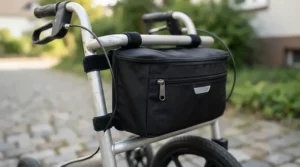
A three wheel walker with front pouch solves the oldest walker problem: you have two hands, and both are busy gripping. Storage on the frame frees them.
Pouches differ more than they look. The Carex 3 Wheel Walker advertises a large bag with pockets, the Vive Mobility 3 Wheel Walker a removable bag, and the Medline 3-Wheel Steel Rollator a basket plus a pouch. Here’s what actually matters.
Mounting position. A front pouch rides over the pivoting wheel. Load it heavy and you make the front end sluggish and jumpy. Keep the weight low and centered, or rest heavier things in a basket if your model has one.
Removability. A bag you can detach is a bag you can bring to the couch. It also lets you wash it, which matters after a leaky grocery run.
Access. Zippers beat open tops if you walk outdoors, but a bag you can’t reach comfortably will end up unused. Check that you can open it without bending sharply.
Weight discipline. Treat the pouch like a purse, not a trunk. A few pounds of essentials are fine. A gallon of milk changes how the walker steers and shifts the center of gravity toward the front. When in doubt, make two trips, or have groceries delivered.
If you need to carry hot drinks, a tray beats a pouch every time.
How to Choose a 3 Wheel Rollator for Small Apartments
- Measure your doorways and hallways first. Write down the narrowest passage, including bathroom doors. Compare it against the listed overall width of any candidate, then leave a little margin for your hands and elbows.
- Match capacity to your body weight. The PLANETWALK Premium 3 Wheel Rollator lists 260 lb, while others list 275 to 300 lb. Don’t shop near the limit; frames flex more when pushed.
- Decide whether you need a seat. Only some three-wheelers, like the Medline 3-Wheel Steel Rollator, include one. If you need frequent rests, a seat matters.
- Check the wheels. Eight-inch wheels cross thresholds more smoothly than seven. Locking wheels help when parked.
- Test the brakes. Weak brakes are the most common complaint in the category. Squeeze them in the store if you can.
- Get the height right. Handles should sit near your wrist crease with arms relaxed. Poor fit makes any aid less safe.
- Weigh storage against stability. More pouches mean more load on the front wheel, so choose just enough.
Finally, ask a physical therapist to confirm fit. Many people buy mobility aids without training, and clinicians generally recommend professional fitting when possible.
Your First 30 Days: Setup, Daily Use and Maintenance
Transformation starts the moment you open the box. Here’s a practical routine that product pages rarely give you.
Day 1: setup. Assemble on a flat surface, set the handles to wrist height, and test the folding lock three times until it feels routine. Squeeze both brakes and push the walker. It should resist.
Week 1: rehearse. Practice the apartment’s tight spots with a helper nearby: bathroom entrance, kitchen corner, bedroom doorway. A university geriatrics resource advises turning with multiple small steps until you and the walker face the new direction, rather than one big swing. That habit matters even more with a nimble front wheel.
Sitting safely. If your model has a seat, back up to a wall or other firm surface, lock the brakes, then sit. The same resource warns against letting anyone be pushed on a rollator seat. That’s a recipe for a serious fall. You can find it in this Elder Care guide to choosing the correct walker.
Weekly maintenance. Wipe the wheels and check for hair or grit in the front pivot. A sticky caster ruins maneuverability.
Monthly checks. Tighten any wobbly bolts, test brake tension, and confirm the fold latch still clicks. The Drive Medical Nitro Euro Style 3 Wheel Rollator drew complaints about a stiff latch and plastic parts, so inspect those components more often.
Common first-month mistakes: leaning forward over the walker, loading the pouch too heavy, and skipping the brakes “just for a second.”
Real-World Scenarios: Three Apartment Profiles
Scenario 1: Maria, 72, studio apartment, steady walker. She needs a light touch of support to and from the kitchenette and mailroom. Budget is modest. The Vive Mobility 3 Wheel Walker or PLANETWALK Premium 3 Wheel Rollator fits: light, narrow and easy to fold behind the door. She uses the walker daily but never for long outings.
Scenario 2: Robert, 80, one-bedroom, recovering from surgery. He wants a rest option for the kitchen. The Medline 3-Wheel Steel Rollator offers a seat, tray and basket at a modest price. Because he’s regaining strength, his therapist should confirm that three wheels give him enough stability; if not, a four-wheel model with a wider base is the safer choice despite the footprint.
Scenario 3: Denise, 68, third-floor walk-up, balance concerns. She likes how a tri-walker fits her hallway but worries about wobble. The Helavo 3 Wheel Walker with Double Front Wheels targets precisely that tradeoff. She should skip the Drive Medical Nitro Euro Style 3 Wheel Rollator, given reviewers’ stability and brake complaints.
Each profile shows the same logic: start with the body, then the home, then the product.
Problem → Solution Guide for Tight Hallways and Bathrooms
Problem 1: The walker won’t fit through the bathroom door. Solution: measure the door opening, not the wall. If it’s too tight, park the walker outside and use grab bars inside, ideally installed by a professional.
Problem 2: The front wheel flutters. Solution: steer with both hands, slow down, and clean the caster. If it persists, consider the Helavo 3 Wheel Walker with Double Front Wheels.
Problem 3: Thick rugs snag the wheels. Solution: remove throw rugs or tape down edges. Sources warn that soft surfaces are where three-wheelers struggle most.
Problem 4: Storage is awkward. Solution: choose a model with a self-locking or two-side fold, like the PLANETWALK Premium 3 Wheel Rollator or HOMLAND Foldable 3 Wheel Walker, and designate one parking spot.
Problem 5: Tired legs on longer trips. Solution: this may signal you need a four-wheel rollator with a seat. Talk to your clinician rather than pushing through.
Long-Term Cost and Value: What Three Wheels Really Cost
Sticker price is only part of the story. A cheaper steel frame like the Medline 3-Wheel Steel Rollator saves money upfront but adds weight you’ll feel every time you lift it into a car or closet. A lighter aluminum model like the HOMLAND Foldable 3 Wheel Walker costs a bit more and saves wrists.
Warranty is hidden value. The Vive Mobility 3 Wheel Walker lists a lifetime guarantee, the HOMLAND Foldable 3 Wheel Walker one year. If you expect years of daily use, longer coverage can matter more than a ten-dollar price difference. Then there’s replacement parts: wheels, grips and bags eventually wear, so check that spares are available.
Insurance is another angle. Medicare and other insurers have specific rules on mobility equipment, and what’s covered depends on medical necessity and the supplier. Ask your doctor and the supplier before you buy; don’t assume.
Finally, consider cost per day. A $100 walker used daily for three years costs pennies per use, while a “bargain” that doesn’t fit your body may cost a fall. That is the most expensive outcome of all, and it is why fit and professional advice belong in every budget.

FAQ
❓ Are 3 wheel rollators safe for people with balance problems?
❓ How do I know if a three wheel walker will fit through my bathroom door?
❓ Can a three wheel walker with front pouch carry groceries?
❓ Does Medicare cover a 3 wheel rollator?
❓ What is the best 3 wheel rollator for small apartments on a budget?
Conclusion
Choosing a 3 wheel rollator for small apartments comes down to one honest question: how much support do you need, and how much space do you have? If you walk steadily and your home is tight, a three-wheeler gives you real maneuverability, a smaller storage footprint and fewer clipped cabinets. If you lean hard on your walker, the stability tradeoff may not be worth it, and a four-wheel or standard walker is the wiser pick.
For most apartment dwellers, my analysis points to three starting places. The Vive Mobility 3 Wheel Walker and PLANETWALK Premium 3 Wheel Rollator are the light, narrow, sensible defaults. The Medline 3-Wheel Steel Rollator is the budget option with a seat. And the Helavo 3 Wheel Walker with Double Front Wheels is the one to examine if wobble worries you. Treat the Drive Medical Nitro Euro Style 3 Wheel Rollator with caution given the brake and stability feedback.
Before you buy, measure your doors, check the listed capacity, and ask a physical therapist about fit. For broader context on wheeled versus non-wheeled walkers, this Canadian health technology report on wheeled walkers is a useful starting point for your conversation with a clinician.
Recommended for You
- Lightweight Folding Rollator for Car Trunk: 7 Best Picks (2026)
- Euro-Style Rollator for Narrow Hallways: 7 Proven Picks (2026)
- Rollator With Seat for People With COPD: 7 Best Picks (2026)
Disclaimer: This article contains affiliate links. As an Amazon Associate, I earn from qualifying purchases. If you purchase products through these links, we may earn a small commission at no additional cost to you.
✨ Found this helpful? Share it with your friends! 💬🤗
