
In This Article
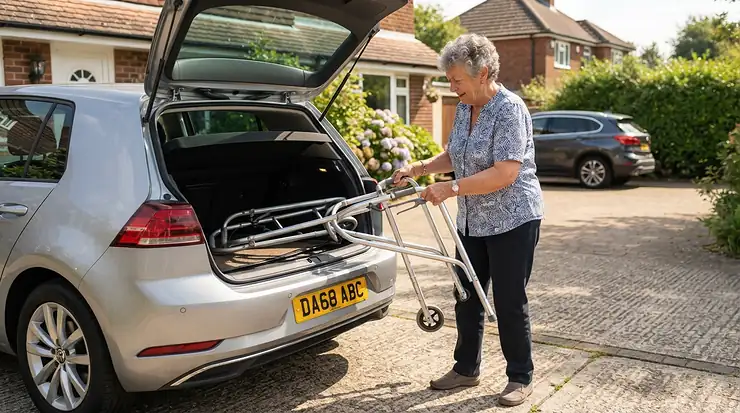
A lightweight folding rollator for car trunk use is a four-wheeled walker with a seat and hand brakes. Its frame is light enough to lift (usually 10 to 18 pounds), and it collapses small enough to slide into a trunk or onto a back seat without a wrestling match. Weight, folded dimensions, and fold security decide whether it works in real life.
Most rollators fold. Far fewer fold well. The category traces back to Swedish designer Aina Wifalk, who built the first rollator in 1978 after living with polio, and the core idea hasn’t changed: a walker that rolls, brakes, and lets you sit when your legs call a timeout. What has changed is how obsessively manufacturers now shave pounds and inches. That’s great news if you load a walker into a car several times a week. It’s also a minefield, because “compact” on a product page can mean anything from a 10-inch-wide bundle to a 34-inch-tall slab that still won’t clear your trunk lip.
This guide skips the brochure copy. I compared seven real models on the things that decide a trunk-loading routine: actual weight, folded dimensions, how the fold behaves when you’re holding a bag of groceries in the other hand, and who each model suits. Where the data is solid, I’ll say so. Where it isn’t, I’ll say that too. Spec figures come from manufacturer and retailer listings, and review sentiment is aggregated from reviews and independent roundups. I haven’t personally tested these walkers.
If you’re the caregiver doing the lifting, or the rollator user doing it yourself, the goal is the same: less strain, fewer surprises at the curb.
Quick Comparison: Lightweight Folding Rollator for Car Trunk Options at a Glance
| Rollator | Approx. Weight | Folded Size (as listed) | Capacity | Price Range | Best For |
|---|---|---|---|---|---|
| Stander EZ Fold-N-Go Rollator | 14–14.5 lb | ~11″ x 10″ footprint | 250 lb | $180–$320 | Smallest trunks, back-seat stowing |
| Medline Superlight Folding Aluminum Rollator | 11–12.6 lb | ~9.4″ wide (listing) | 250 lb | Under $150 | Tight budgets, lightest aluminum |
| Drive Medical Compact Folding Rollator | ~15.4 lb | ~14.9″ x 9.25″ x 25″ | 300 lb | Mid-range | Narrow fold plus 8″ wheels |
| PLANETWALK Super Lightweight Rollator | ~13 lb | Verify on listing | 300 lb | Budget to mid | One-hand fold, paved paths |
| Drive Medical Nitro Aluminum Rollator | ~17.5 lb | 10″ W x 27.75″ L x 33.5″ H | 300 lb | $200–$300 | Rough pavement, big casters |
| Hugo Elite Rollator | ~15–18 lb | Varies by model | 300 lb | $150–$400 | Side-fold plus storage |
| byACRE Carbon Ultralight Rollator | ~10.6 lb | Folds flat | 285 lb | $600–$900 | Lowest possible lift weight |
Looking at the table, the Medline Superlight Folding Aluminum Rollator and byACRE Carbon Ultralight Rollator win on pure lifting weight, but at opposite ends of the budget. The Stander EZ Fold-N-Go Rollator is the folded-size champion, and it gives up some capacity to get there. If you need 300 pounds of headroom plus bigger wheels, the Drive Medical Compact Folding Rollator and Drive Medical Nitro Aluminum Rollator trade a few extra pounds for a sturdier ride.
💬 Just one click — help others make better buying decisions too!😊
Top 7 Lightweight Folding Rollators for Car Trunk Use: Expert Analysis
1. Stander EZ Fold-N-Go Rollator — smallest folded footprint here
The party trick is the fold. Listings put the Stander EZ Fold-N-Go Rollator at roughly 11 by 10 inches when collapsed, which Stander markets as about three times smaller than an average rollator. Note that the same platform shows up under other labels (Able Life Space Saver, Signature Life Elite Travel), so match specs rather than names when shopping.
Listed weight is about 14 to 14.5 pounds, with a 250-pound capacity and 6-inch wheels. The standard size fits handle heights of 33 to 36 inches, and a short version covers roughly 4’9″ to 5’3″. In practice, that folded profile is what lets it ride behind the front seats or across a back seat when the trunk is full of luggage. The 6-inch wheels are the trade-off: they’re happiest on sidewalks and indoor floors, not gravel.
Analytically, this is the pick for compact sedans, hatchbacks with shallow cargo wells, and caregivers who also haul strollers or groceries. Reviewers commonly report that it stands upright when folded and is light enough to swing in and out of a car, though some find the seat firm. The seat is a perch rather than a lounge chair, around 18.5 inches wide and just a few inches deep.
Pros:
- ✅ Tiny folded footprint fits nearly any vehicle
- ✅ Stands upright on its own when closed
- ✅ Arrives assembled, no tools needed
Cons:
- ❌ 250 lb capacity limits heavier users
- ❌ Small wheels struggle on rough ground
Prices run roughly $180–$320 depending on seller and color (check current price). Verdict: unbeatable for storage-obsessed drivers, less ideal for rugged terrain.

2. Medline Superlight Folding Aluminum Rollator — lightest aluminum frame on a budget
If your top priority is a light lift, start here. The Medline Superlight Folding Aluminum Rollator is listed between 11 and 12.6 pounds depending on the retailer, which puts it near the bottom of the weight range for aluminum models. Capacity is 250 pounds, wheels are 6 inches, and handle height adjusts from about 29.5 to 36 inches, so shorter users are covered too.
That low weight is the whole story, and it matters more than most spec-sheet items. A walker you can lift one-handed is one you’ll actually bring along. It’s also a genuine aluminum rollator that folds flat, with one listing showing a collapsed width of about 9.4 inches (verify against your own trunk). The honest caveat: it’s a no-frills machine. The seat is functional, the wheels are small, and nothing here will cushion a bumpy sidewalk.
Aggregated review sentiment is mostly positive, with ratings around the mid-4-star range on several retailer pages and thousands of ratings on at least one. A recurring complaint is that the walker doesn’t stay folded on its own, with one reviewer suggesting a Velcro strap to keep it closed. That’s a ten-minute fix, but plan for it.
Pros:
- ✅ Among the lightest aluminum options available
- ✅ Adjustable arms and seat height
- ✅ Budget-friendly entry price
Cons:
- ❌ Doesn’t self-stand or self-latch when folded
- ❌ 6-inch wheels limit outdoor comfort
Expect well under $150 on most listings (check current price). Verdict: outstanding value for light, occasional car trips.
3. Drive Medical Compact Folding Rollator — narrow fold with 8-inch wheels
This one splits the difference between featherweight and sturdy. The Drive Medical Compact Folding Rollator lists at about 15.4 pounds with a 300-pound capacity and 8-inch wheels. Those larger wheels roll over expansion joints and door thresholds that stop smaller wheels cold. Open dimensions are roughly 26 by 26.8 inches, with about 19 inches between the arms, and the padded seat measures around 18 by 8.7 inches.
An independent roundup reports folded dimensions near 14.9 by 9.25 by 25 inches, one of the narrower collapsed profiles in this group. I couldn’t verify that figure from the manufacturer’s page, so measure before you commit. If it holds, the narrow 9-inch depth lets it tuck beside luggage instead of eating the whole trunk floor. A cane holder is included, and assembly is tool-free.
My analysis: this suits someone who needs real stability and wheel size but still lifts the walker into the car regularly. At 15.4 pounds, it’s roughly three pounds heavier than the ultralights, so it’s worth testing the lift if upper-body strength is limited.
Verified independent user-review depth was thin in the sources I could access, so I won’t claim a rating. Look at current retailer reviews before purchase.
Pros:
- ✅ 8-inch wheels handle thresholds and cracks
- ✅ 300 lb capacity gives real headroom
- ✅ Narrow folded profile reported
Cons:
- ❌ Heavier than the ultralight models
- ❌ Folded size figure needs verifying
Pricing sits in the mid-range tier (check current price). Verdict: the sensible all-rounder if wheel size matters.
4. PLANETWALK Super Lightweight Rollator — one-hand fold at 13 pounds
The PLANETWALK Super Lightweight Rollator pitches itself on two things: a listed weight around 13 pounds and a one-hand fold mechanism. It pairs that with 8-inch wheels and a 300-pound capacity, a combination that’s rare at this weight. Open dimensions are listed near 26.5 by 25.2 by 35 inches.
Why does that matter? A one-hand fold mechanism changes the whole curbside routine. When one hand is busy holding a car door or a caregiver’s arm, a fold that needs two hands and a sit-down is a fold you’ll dread. A single-handed collapse also keeps your balance intact, since you’re not releasing a grip to wrestle with latches.
One independent roundup recommends it for outdoor paved pathways, which fits its larger wheels. Analytically, it looks like a smart fit for users who walk on sidewalks and parking lots more than carpeted hallways. I couldn’t find consistent folded dimensions in the sources, so confirm the numbers against your trunk before ordering.
Verifiable review aggregates for this model were limited in my research. Rather than guess, I’d suggest reading recent buyer reviews specifically about folding, latching, and brake feel.
Pros:
- ✅ One-hand fold suits busy-handed loading
- ✅ Light 13 lb frame with 300 lb rating
- ✅ 8-inch wheels for pavement
Cons:
- ❌ Folded size not consistently published
- ❌ Smaller verified review pool
Expect a budget-to-mid price band (check current price). Verdict: promising spec balance, but verify the fold dimensions first.
5. Drive Medical Nitro Aluminum Rollator — 10-inch casters for rough pavement
Big front wheels are the Nitro’s calling card. The Drive Medical Nitro Aluminum Rollator uses 10-inch front casters and 8-inch rear wheels on a lightweight aluminum frame, which glide over cracked sidewalks better than any 6-inch setup on this list. Listed weight is about 17.5 pounds (excluding the storage bag), capacity is 300 pounds, and handles adjust from roughly 33.25 to 38.25 inches.
Folded dimensions are listed at 10 inches wide by 27.75 inches long by 33.5 inches tall. That height deserves attention: it’s a slim slab, but a tall one. In a sedan, it generally lies flat across the trunk floor rather than standing upright. The brake cable runs inside the frame, which protects it from snagging, and the warranty lists a limited lifetime on the frame with five years on brake and handle housing.
The honest trade-off is the lift. At 17.5 pounds, it’s the heavier end of “lightweight,” and it won’t suit anyone who struggles above 15. Reviewer sentiment is generally positive, with ratings in the mid-4-star range across several retailers. A recurring note is that it may not stay folded on its own, so keep a strap handy.
Pros:
- ✅ Large casters smooth out rough pavement
- ✅ Interior brake cable resists snagging
- ✅ Strong warranty on frame and brakes
Cons:
- ❌ Heaviest aluminum model in this group
- ❌ Tall folded height limits upright stowing
Prices commonly land around $200–$300 (check current price). Verdict: best for outdoor-heavy users who can handle the extra pounds.

6. Hugo Elite Rollator — side-fold design with built-in storage
The Hugo Elite Rollator is a side-fold walker that bundles useful extras: an under-seat storage bag, and some versions add a saddlebag. It rides on 8-inch wheels, supports 300 pounds, and uses tool-free assembly. Handle height is listed up to about 38 inches.
Weights vary by model and retailer, from around 15 to 18 pounds, so read the exact variant on the page. That’s a wide enough range to matter if you’re lifting daily. It folds and locks for storage, and a locked fold is a real asset during trunk loading: the walker stays one object instead of two flopping halves.
Analytically, I’d point this one at users who want the walker to carry things (pharmacy bags, a light jacket) and are willing to trade a few pounds for it. Aggregated retailer feedback is mostly positive, with one summary noting it can be excellent but that some buyers report problems with the locking mechanism, so test that latch early. One buyer praised Hugo’s customer service after replacing a worn basket.
Pros:
- ✅ Side-fold locks closed for tidy transport
- ✅ Included storage bag adds everyday utility
- ✅ 8-inch wheels roll over uneven surfaces
Cons:
- ❌ Listed weight varies between variants
- ❌ Some reports of latch issues
Street prices swing widely, roughly $150–$400 depending on retailer and bundle (check current price). Verdict: practical and storage-friendly, as long as the lock behaves.
7. byACRE Carbon Ultralight Rollator — lowest lift weight money can buy
Here’s the outlier. The byACRE Carbon Ultralight Rollator swaps aluminum for a carbon-composite frame, bringing listed weight to roughly 10.6 pounds with a 285-pound capacity. It folds flat, ships assembled, and includes an organizer bag, according to retailer listings. Independent roundups call it the lightest frame in their comparisons.
Is that worth the cost? For the right person, yes. If a caregiver is lifting a walker dozens of times a month, or the user has significant shoulder, wrist, or back limitations, every pound counts. Carbon’s stiffness also tends to keep the frame from flexing, though I’d treat that as a design characteristic rather than a guarantee.
The catch is price. This sits in a different league from the aluminum options, and unlike them, it isn’t an aluminum rollator that folds flat; it’s carbon. Verified customer-review depth in my sources was limited, so I won’t summarize sentiment beyond saying independent roundups rate its weight advantage highly. Check recent buyer reviews on durability and brake feel before paying a premium.
Pros:
- ✅ Lightest frame in this comparison
- ✅ Folds flat and arrives assembled
- ✅ Organizer bag included
Cons:
- ❌ Premium price versus aluminum rivals
- ❌ Smaller verifiable review pool
Expect roughly $600–$900 depending on size and seller (check current price). Verdict: worth it only if lifting weight is your single biggest bottleneck.
How to Choose a Lightweight Folding Rollator for Car Trunk Use
Picking one isn’t about finding “the best.” It’s about matching five physical realities. Here’s the short version:
- Start with your lift limit, not the spec sheet. Add a pound or two for the bag and accessories, then pick a walker you can raise to trunk height with straight arms. If 15 pounds feels heavy, stay under 13.
- Measure the trunk opening, not the trunk volume. Hinge arms, lid lips, and a tall cargo floor often matter more than cubic feet.
- Check the folded dimensions, then picture the orientation. A walker that stands upright needs height; one that lies flat needs length and width.
- Match wheel size to where you walk. Six-inch wheels suit smooth floors; eight to ten inches handle sidewalks and thresholds.
- Confirm the capacity with margin. Pick a rating comfortably above the user’s weight, as Mayo Clinic’s walker guidance advises against overloading these devices.
- Test the fold before the return window closes. A fold that needs two hands and a bruised knuckle is a fold you’ll stop using.
- Set the handle height correctly. Mayo Clinic’s walker guide emphasizes fitting the walker so your arms rest comfortably, which eases stress on shoulders and back. A common rule of thumb is handle grips at the wrist crease when standing upright.
Treat it as a checklist. If a model fails steps one through three, the rest is irrelevant.
Folded Dimensions: How to Measure Your Trunk Before You Buy
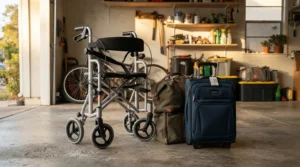
Folded dimensions are the number most buyers glance at and then forget to compare against their actual car. Don’t. Measure three things: the opening width at its narrowest point (usually between hinge arms), the opening height from the trunk floor to the lid edge, and the usable depth from opening to the back seat. Then subtract two inches from each for fingers and wiggle room.
Now compare. The Stander EZ Fold-N-Go Rollator needs roughly an 11 by 10 footprint, so it fits where nothing else does, including behind seats. The Drive Medical Nitro Aluminum Rollator collapses to about 10 inches wide but needs around 28 by 34 inches of length and height, which is fine for a trunk floor but not for a shallow cargo well. The Drive Medical Compact Folding Rollator reportedly sits near 15 by 9 by 25, a middle path.
One more wrinkle: cargo floor height. Many sedans have a lip you must lift over, and that extra lift changes the effective weight of a 15-pound walker. For a hatchback or SUV, the opening is typically wider and the floor is closer to hand, so most of the folded-size anxiety evaporates. Always confirm dimensions on the product’s own spec sheet, since listings differ.
One-Hand Fold Mechanism: What to Test Before You Commit
A one-hand fold mechanism isn’t a luxury. It’s the difference between a smooth trunk routine and a balancing act on a sloped driveway. Most designs use a pull strap or a seat-center handle: lift the strap, and the frame collapses sideways.
What separates good from frustrating is what happens after the fold. Does it self-latch? Does it stand upright? Does it need a buckle? Here’s what listings and reviewers report:
| Rollator | Fold Behavior | Stands Upright? | Strap/Latch Notes | Best For |
|---|---|---|---|---|
| Stander EZ Fold-N-Go Rollator | Compact collapse | Yes, per listings | Includes buckle in some versions | Quick stowing |
| Medline Superlight Folding Aluminum Rollator | Folds flat | Not on its own, per reviewers | Add a strap | Budget buyers |
| Drive Medical Nitro Aluminum Rollator | Pull-handle fold | Some report no | May need a strap | Outdoor users |
| Hugo Elite Rollator | Side-fold and lock | Locks closed | Test the latch early | Storage seekers |
The pattern is clear: the smallest models often hold their fold best, while some budget and mid-range frames flop open. If a model doesn’t self-latch, a $5 hook-and-loop strap solves it. If it doesn’t self-stand, it’ll need to lie flat in the trunk. A walker that locks closed and stands up is easier to hand to a caregiver mid-transfer, too.
Vehicle Loading: A Step-by-Step Routine That Saves Your Back
Good vehicle loading is mostly choreography. Here’s a routine that works for most sedans and hatchbacks:
- Park with room to work. Leave space behind the car so the trunk opens fully and the walker has somewhere to stand.
- Seat the passenger first. Brakes locked, walker nearby, and the rider settled before anyone starts folding.
- Lock the brakes before folding. Releasing them keeps the walker from rolling away while you’re bent over.
- Fold, then secure. Use the one-hand fold mechanism, then add a strap if the frame wants to swing open.
- Lift with legs and keep it close. Hold the walker against your torso rather than at arm’s length, and pivot with your feet instead of twisting.
- Place it flat or upright per its design. Slide it against the trunk wall, behind the wheel well, so it can’t shift.
- Add a barrier. A rolled towel or small foam pad stops the frame from rattling or scratching.
First-30-day mistakes: forgetting to lock the brakes, folding with a bag still hanging from the handles, and sliding the walker over a dirty trunk lip so the wheels grind grit into the next indoor floor. Wipe wheels before heading back inside.
✨ Don’t Miss These Exclusive Deals!
🔍 Take your car-trip independence to the next level with these carefully selected rollators. Click on any highlighted item to check current pricing and availability. These picks will help you load, lift, and go with confidence!
Easy Lift Rollator for Caregivers: Protecting the Person Doing the Lifting
An easy lift rollator for caregivers is judged by more than its weight number. Grip points, balance, and how the walker hangs in your hand all shape how hard the lift feels. A well-balanced 15-pound frame with a clear carry handle can feel easier than an awkward 12-pound one with nowhere to grab.
Look for a frame that locks closed, so it doesn’t swing during the lift. Look for smooth tubing and a handle area that’s easy to grip, and keep the wheels from dragging on clothes. Research on patient handling from NIOSH’s lifting guidance for healthcare workers makes a broader point worth borrowing: equipment and design choices cut injury risk more reliably than technique alone. A rollator isn’t a patient, of course, but the same principle applies when you’re lifting one repeatedly.
Practical moves help. Fold the walker before you reach the car, so you’re not wrangling hinges while holding a door. If you share driving duties, alternate who lifts. And consider two-handed carries when stairs or curbs are involved. If you’re regularly loading a rollator and your own back is complaining, the ultralight Medline Superlight Folding Aluminum Rollator or the premium byACRE Carbon Ultralight Rollator are the logical first look. The Stander EZ Fold-N-Go Rollator helps in a different way, since its small stowed size means less awkward reaching.
Real-World Scenarios: Three Drivers, Three Rollators
Scenario 1: The retired teacher with a compact sedan. She drives herself to the library and grocery store four times a week. The trunk is small, and she lifts the walker alone. The Stander EZ Fold-N-Go Rollator fits behind her seat, so she never fights the trunk lip. Budget: moderate. Frequency: daily.
Scenario 2: The adult son who drives his dad to appointments. Weekly physical-therapy visits mean a lot of curb time, and Dad is around 240 pounds. He needs a rating with margin and wheels that handle parking-lot seams. The Drive Medical Compact Folding Rollator (300 lb, 8-inch wheels) fits better than a 250-pound ultralight, and the son accepts the extra three pounds.
Scenario 3: The retiree who travels by car and rail. Long weekends mean repeated loading and unloading, plus stairs at stations. Here the premium byACRE Carbon Ultralight Rollator earns its cost: less weight on every lift adds up. A moderate-budget alternative is the Medline Superlight Folding Aluminum Rollator, paired with a strap.
The common thread: the best rollator is the one matched to your trunk, your terrain, and your lifting limit, not the one with the biggest marketing claim.

Problem and Solution: Fixing the Five Most Common Trunk-Loading Headaches
Problem: it springs open mid-lift. Solution: add a hook-and-loop strap or a short bungee. This is a common complaint with some budget frames, so don’t treat it as a defect, just a known quirk.
Problem: it won’t clear the trunk lip. Solution: rotate it. Flat-on-its-side often clears where upright doesn’t. If it still catches, consider a model with a shorter folded height like the Stander EZ Fold-N-Go Rollator.
Problem: wheels leave grime in the trunk. Solution: keep a washable mat or towel as a liner and wipe the tires before stowing.
Problem: the fold feels stiff. Solution: check for debris in the hinge, and avoid forcing it. If a latch binds new out of the box, return it; hinge issues rarely improve.
Problem: it rattles on the road. Solution: wedge it with a rolled blanket or a small bag, and put the heaviest part at the bottom.
None of these fixes cost more than a few dollars. They’re cheaper than a replacement.
Aluminum Rollator That Folds Flat vs. Steel vs. Carbon: What the Material Really Means
| Material | Typical Weight | Typical Capacity | Price Tier | Best For |
|---|---|---|---|---|
| Aluminum (e.g., Medline Superlight Folding Aluminum Rollator) | 11–17.5 lb | 250–300 lb | Budget to mid | Most trunk-loading households |
| Steel (e.g., Medline steel models) | 17–20 lb | 300–350 lb | Budget | Heavier users, fixed-use homes |
| Carbon composite (byACRE Carbon Ultralight Rollator) | ~10.6 lb | ~285 lb | Premium | Minimum lift weight |
| Heavy-duty steel | ~25–30 lb | 400–500 lb | Mid to premium | Bariatric needs |
Reading the table, an aluminum rollator that folds flat is the sweet spot for most households: it’s light enough for regular lifting, and sturdy enough to carry 300 pounds in several models. Steel adds capacity and often costs less, but you pay in pounds at every trunk load. Carbon wins on weight but demands a much bigger budget.
If the person using the walker is closer to the capacity ceiling, don’t chase weight at the cost of safety. Step up to a 300-pound aluminum frame like the Drive Medical Nitro Aluminum Rollator rather than squeezing under a 250-pound limit.
Features That Actually Matter (And Those That Don’t)
Matter: weight, folded dimensions, a fold that latches, wheel size for your terrain, and brakes you can squeeze with tired hands. These decide whether the walker gets used.
Matter somewhat: a seat you can actually sit on for a few minutes, a handle range that fits your height, and a storage pouch that won’t tear.
Mostly don’t: cup holders, flashy colors, and tray add-ons that add pounds. A cup holder is lovely until it’s the reason the fold snags on the trunk lip.
One detail people overlook is brake feel. Brakes that need a hard squeeze are a problem for arthritic hands, so check how the lever pulls before you buy. Another is seat depth: models with a narrow seat, like the Stander EZ Fold-N-Go Rollator, are meant for short rests, not long waits at the bus stop. Match features to your actual day, not an imagined one.
Long-Term Cost and Maintenance
A rollator’s real cost is spread over years. A budget frame like the Medline Superlight Folding Aluminum Rollator may cost a fraction of a premium one, but if you replace a worn frame sooner, the math tightens. A rollator used daily for three to five years often justifies spending for a better lock, bigger wheels, and a longer warranty.
Maintenance is simple. Wipe wheels weekly, check brake cables, and tighten wheel bolts monthly. Look for cracks around hinges, since those fold points endure the most stress. Replace worn tires and grips before they slip. Warranty terms matter too: the Drive Medical Nitro Aluminum Rollator lists a limited lifetime on its frame, with five years on brake and handle housing, which is a meaningful signal compared with a one-year warranty.
Cost per use is the honest metric. A premium walker used four times a week for five years comes to roughly a few cents per trip. A cheap one that stays in the closet costs far more per useful outing.
Safety, Fit, and Fall-Prevention Basics
A light walker is only useful if it’s safe. Brakes should be locked before sitting, and the seat is for resting, not for being pushed around in. Handle height should be adjusted to the user, and a new walker should be checked by a doctor or physical therapist when possible.
For broader fall-prevention resources, the CDC’s STEADI initiative offers brochures and tools for older adults, caregivers, and clinicians. It’s a good starting point for home-safety checks and conversations with a healthcare provider.
Never overload the walker or hang heavy bags on the handles, which can tip it. Inspect brakes and wheels regularly, and retire any rollator with bent tubing or a loose frame. And remember that no rollator replaces professional guidance: if balance is a concern, a clinician can recommend the right type and fit.

FAQ
❓ Will a lightweight folding rollator fit in a small sedan trunk?
❓ How much should a rollator weigh for easy lifting?
❓ Do folding rollators stay folded on their own?
❓ Can a rollator go on the back seat instead of the trunk?
❓ Is aluminum strong enough compared with steel?
Conclusion
The best lightweight folding rollator for car trunk use isn’t the lightest one on paper. It’s the one that disappears into your car without a fight. For the tightest spaces, the Stander EZ Fold-N-Go Rollator is the folded-size champion. For budget-conscious lifters, the Medline Superlight Folding Aluminum Rollator keeps weight low and cost lower. If you need bigger wheels and a 300-pound rating, the Drive Medical Compact Folding Rollator and Drive Medical Nitro Aluminum Rollator are the sturdy middle ground, while the PLANETWALK Super Lightweight Rollator is worth a look for its one-hand fold. The Hugo Elite Rollator adds storage and a locking side-fold, and the byACRE Carbon Ultralight Rollator is the premium answer for anyone whose biggest enemy is lifting weight.
Before you buy, do three things: measure your trunk, verify the folded dimensions on the exact model, and test the fold in the first return window. Add a strap if the frame wants to flop. And if you’re a caregiver, protect your own back as carefully as you protect theirs.
✨ Ready to simplify every trip? 🔍 Compare current pricing and availability on your shortlist, then pick the rollator that loads easily, lifts lightly, and keeps your independence rolling. 🚗💨
Recommended for You
- 3 Wheel Rollator for Small Apartments: 7 Best Proven Picks 2026
- Euro-Style Rollator for Narrow Hallways: 7 Proven Picks (2026)
- Rollator With Seat for People With COPD: 7 Best Picks (2026)
Disclaimer: This article contains affiliate links. As an Amazon Associate, I earn from qualifying purchases. If you purchase products through these links, we may earn a small commission at no additional cost to you.
✨ Found this helpful? Share it with your friends! 💬🤗
