

In This Article
A euro-style rollator for narrow hallways is a lightweight three- or four-wheel walker with large front casters, a slim frame and hand brakes close to the grips. Its job is to slip through tight doorways, pivot around furniture, and fold small when the hallway wins.

Most people shop for a rollator the way they shop for a sofa: they look at the seat, the color and the price, then discover too late that it won’t clear the bathroom door. The number that matters is overall width, which is easy to overlook. The Mayo Clinic’s walker guide says a walker with a seat helps if you need rest breaks, and a basket helps if you shop. Neither feature matters if the frame jams in your doorway.
This guide ranks seven real models for the euro-style rollator for narrow hallways problem. Some are true euro-style designs with big front casters. Some are slimmer three-wheelers that earn their place on width alone. We also cover a compact indoor rollator for tight doorways, a euro style walker with tight turning radius, the hand brake loop lock, and the stow-away basket, with real specs interpreted rather than recited.
Prices below are ranges, not quotes, and they move constantly. Check current price on the listing before you decide.
Quick Comparison: Euro-Style Rollator for Narrow Hallways at a Glance
| Product | Open width (verify on listing) | Weight | Wheels | Price range | Best For |
|---|---|---|---|---|---|
| Drive Medical Nitro Euro Style (RTL10266) | ~23″ base (some listings show larger overall) | 17.5 lb | 10″ front casters | ~$240-$350 | Smooth, nimble indoor handling |
| Drive Medical Nitro Euro Style 3-Wheel (RTL10266TWHL) | Check listing | Check listing | 9″ front wheel | ~$190-$210 | Pivoting in cramped corners |
| NOVA Zoom 20 | 24.5″ | 16 lb | 8″ | ~$220-$260 | Users who need seat-height sizing |
| Rollz Motion Performance | ~26.5-27″ | ~25 lb | 8″ front, 12″ rear | ~$1,300-$1,650 | Long outings plus wheelchair backup |
| Vive Mobility Narrow Rollator | 23.5″ | 19 lb | Check listing | Check current price | Tight doorways with a seat |
| Vive Mobility 3 Wheel Walker | 21″ | 11 lb | 8″ | ~$120-$155 | The narrowest, lightest option |
| Hugo Mobility Explore Side-Fold | 25″ | 15.4 lb | 8″ | ~$220-$350 | Folding basket and easy storage |
The pattern is clear. The Vive Mobility 3 Wheel Walker is the narrowest and lightest, but it has no seat. The Drive Medical Nitro family trades a few inches of width for large casters that handle thresholds and rug edges better. The Rollz Motion Performance costs several times more, and its ~27-inch frame isn’t a narrow-hallway frame at all. Its pitch is endurance and the wheelchair conversion.
Budget buyers should note that the NOVA Zoom 20 and Hugo Mobility Explore sit in the middle on both price and width. Measure your tightest doorway before you fall in love with any of them.
💬 Just one click — help others make better buying decisions too!😊
Top 7 Euro-Style Rollator for Narrow Hallways Picks: Expert Analysis
1. Drive Medical Nitro Euro Style Rollator (RTL10266) — 10-inch front casters for effortless pivots
The big front wheels are the personality of this walker, and they are why it dominates “euro-style” searches. The listed specs are a 17.5 lb aluminum frame, 10-inch front casters, 300 lb capacity, one-hand folding, hidden brake cables and a removable zippered bag.
In practice, large casters roll over door thresholds and rug edges without the catch-and-lurch smaller wheels produce. The light frame also means you can lift it over a bathroom sill. One caution: listings disagree on width. Some distributors state a 23-inch base, while others show an overall footprint nearer 27-28 inches. Confirm the overall figure before you trust it in a narrow doorway.
Based on the spec comparison, this is the model for hallways that run roughly 30 inches or wider and for users who want a rollator that feels polished rather than clinical. Retail listings show ratings in the mid-4s across many reviews. Roundup sites keep highlighting indoor maneuverability and the folding mechanism.
Pros:
- ✅ Large casters glide over thresholds
- ✅ Light 17.5 lb aluminum frame
- ✅ One-hand fold and hidden brake cables
Cons:
- ❌ Seat depth is shallow, around 10 inches
- ❌ Overall width may exceed the narrowest doors
Expect roughly the $240-$350 range depending on color and seller. That is a fair premium for the handling.

2. Drive Medical Nitro Euro Style 3-Wheel (RTL10266TWHL) — dual front fork for tight pivots
This is the same family with one wheel removed from the front. The dual-fork design is described as enhancing turning radius, and the 9-inch front wheel is meant to move over most surfaces indoors and out. It arrives assembled.
Fewer wheels mean a shorter wheelbase, so the frame pivots in less floor space. That matters in a hallway that ends at a bathroom door at a right angle. Published details on width and weight are thin on the listings I found, so check the exact dimensions before buying. Treat “enhanced turning radius” as marketing language until you have a measurement.
Based on how three-wheel designs generally behave, this suits someone who walks steadily and mainly needs help turning in cramped spaces. It is a weaker choice for anyone who wants to sit often or needs maximum stability. One retail listing shows a rating around 4.4 from roughly 30 reviews, so the review base is small.
Pros:
- ✅ Short wheelbase for cramped corners
- ✅ Arrives assembled, no tools needed
- ✅ Same Nitro styling at a lower price
Cons:
- ❌ Three wheels offer less stability than four
- ❌ Key dimensions are sparsely published
It sits around the $190-$210 range at the time of research, which is good value for a euro-style frame.
3. NOVA Zoom 20 Rollator — seat-height sizing for a true fit
Most rollators sell one size and hope. The NOVA Zoom line offers 18, 20, 22 and 24-inch seat heights, which helps shorter and taller users avoid a hunched or overreaching posture. The Zoom 20 measures about 24.5″ W x 26″ D x 33.5″ H and weighs 16 lb. It supports 300 lb, rolls on 8-inch wheels and has an 18-inch gap between the handles.
It folds to roughly 24.5″ wide by 12.25″ deep, so it stores flat behind a door. At 24.5 inches open, it is on the borderline for what reviewers call “narrow,” which is generally 24 inches or less. It will fit many standard interior doors but not the tightest older-home bathrooms.
Based on the specs, it suits shorter or taller adults who are frustrated with one-size-fits-all handle heights. The review base on retail listings is small, so rely on the published dimensions rather than star ratings here.
Pros:
- ✅ Multiple seat heights for better posture
- ✅ Folds to about 12 inches deep
- ✅ Light 16 lb aluminum frame
Cons:
- ❌ Open width is borderline for tight doors
- ❌ Fabric pouch rather than a rigid basket
Plan on roughly $220-$260.
4. Rollz Motion Performance — rollator that converts to a wheelchair
This is the outlier. It is a rollator that converts into a transport wheelchair, with a listed width of about 26.5-27 inches, a folded width near 12 inches and a weight of about 25 lb (11.4 kg). The load limit is about 275 lb (125 kg). The front wheels are 8-inch foam-filled and steerable, and the rear wheels are 12-inch pneumatic.
The pneumatic rear tires smooth bumpy ground. They add no help in a narrow corridor, because the frame is wider than most of the others here. Where it earns its keep is the user who walks well indoors but tires halfway through a longer outing and wants to be pushed home.
I could not verify independent review sentiment. The sources I found were mostly retailer descriptions. Read third-party reviews before spending this much.
Pros:
- ✅ Converts to a wheelchair in minutes
- ✅ Pneumatic rear tires soften rough ground
- ✅ Folds to about 12 inches wide
Cons:
- ❌ About 27 inches wide is tight for narrow doors
- ❌ Heaviest and costliest on this list
Expect roughly the $1,300-$1,650 range. It is worth it only if you need the wheelchair mode.
5. Vive Mobility Narrow Rollator — four wheels and a seat in a 23.5-inch frame
This is a steel-frame, four-wheel rollator built around doorways. Roundups list it at 23.5 inches wide, 19 lb, 300 lb capacity, with underseat storage and a 31-36 inch handle range. One roundup names it the top pick for tight doorways and small rooms.
At 19 lb it is heavier than the aluminum models, and you will notice that when you lift it into a car. In exchange you get a seat and a frame narrow enough for most interior doors. Based on the spec comparison, it suits people who need to sit but live in a small apartment.
I could not verify its review count or wheel size, so confirm those on the listing. Roundups praise its fit in small spaces, which is the claim that matters here.
Pros:
- ✅ 23.5-inch frame fits most interior doors
- ✅ Seat plus underseat storage
- ✅ 300 lb capacity
Cons:
- ❌ Steel frame is heavier at 19 lb
- ❌ Key wheel specs are unverified
Check current price, as it varies by retailer and color. It usually lands in the budget tier.
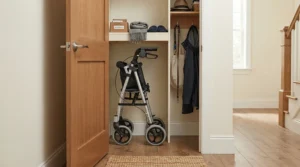
6. Vive Mobility 3 Wheel Walker — narrowest frame at 21 inches
This is the width champion. The listed numbers are a 21-inch open base, a 9-inch folded width, an 11 lb weight, 8-inch wheels and a 35″ x 26″ footprint, with an accessory bag included. It has no seat.
The 21-inch frame clears doorways the others can’t, and 11 lb means you can lift it with one hand. A tri-wheel design pivots tightly, which makes it a euro style walker with tight turning radius in practical terms, even though it isn’t styled like the Nitro. One roundup lists a 4.6 rating across roughly 1,600 reviews, with praise for portability and maneuverability.
It suits active users who want light support and don’t need to sit. If you need a seat, skip it.
Pros:
- ✅ Narrowest frame here at 21 inches
- ✅ Only 11 lb, easy to lift
- ✅ Folds to about 9 inches wide
Cons:
- ❌ No built-in seat
- ❌ Three-wheel layout is less planted than four
Expect roughly $120-$155. It is the best value for tight spaces.
7. Hugo Mobility Explore Side-Fold Rollator — folding basket and side-fold storage
This one is a side-folding four-wheeler with a seat, a backrest and a folding basket. It measures about 25″ W x 28.5″ L x 37″ H, weighs 15.4 lb, and has a 300 lb capacity, 8-inch wheels, a 20-inch seat height and 17.5 inches between the handlebars.
The folding basket is the draw. It collapses when you don’t need it, which helps with storage and with squeezing past doorframes. Summaries note that it is comfortable to sit on and light for its size. A few buyers flag height fit, so check the handle range against your own height.
At 25 inches wide it is not a narrow-hallway specialist. It is a sensible all-rounder for homes with standard doors. Read it as a mid-pack option, not a tight-space champion.
Pros:
- ✅ Folding basket stows when unused
- ✅ Light at 15.4 lb
- ✅ Padded seat with backrest
Cons:
- ❌ 25-inch width is not especially narrow
- ❌ 28.5-inch length adds to turning footprint
Plan on roughly $220-$350. The fold and basket are the value.
Side-by-Side: Weight, Capacity and Seating
| Product | Weight | Capacity | Wheel size | Seat? | Best For |
|---|---|---|---|---|---|
| Drive Medical Nitro Euro Style | 17.5 lb | 300 lb | 10″ front | Yes | Smooth indoor handling |
| Drive Medical Nitro 3-Wheel | Check listing | Check listing | 9″ front | Not verified | Tight pivots |
| NOVA Zoom 20 | 16 lb | 300 lb | 8″ | Yes (padded) | Fit by seat height |
| Rollz Motion Performance | ~25 lb | ~275 lb | 8″ / 12″ | Yes (converts) | Wheelchair backup |
| Vive Mobility Narrow Rollator | 19 lb | 300 lb | Check listing | Yes | Narrow doors with a seat |
| Vive Mobility 3 Wheel Walker | 11 lb | Check listing | 8″ | No | Lightest, narrowest |
| Hugo Mobility Explore | 15.4 lb | 300 lb | 8″ | Yes | Folding basket |
Looking at the table, the Vive Mobility 3 Wheel Walker wins on weight and width, but only if you can live without a seat. The NOVA Zoom 20 and Hugo Mobility Explore match on capacity and weight, so the choice between them comes down to sizing versus the folding basket. The Rollz Motion Performance is the only model here with a wheelchair mode, and it carries a heavy premium for it.
✨ Don’t Miss These Exclusive Deals!
🔍 Take your search for a euro-style rollator for narrow hallways to the next level with these carefully selected products. Click any highlighted product name to check current pricing and availability. A well-chosen frame will help you move confidently through every doorway at home!
How to Choose a Euro-Style Rollator for Narrow Hallways
Follow these steps in order. Each one narrows the field.
- Measure your tightest opening first. Use a tape measure at the narrowest point, often the bathroom door, and measure the clear gap with the door open. Add at least an inch or two of margin beyond the frame’s overall width, because your hands and elbows sit outside the wheels.
- Compare overall width, not handle width. A rollator is narrow if the frame measures about 24 inches or less at its widest point, and handle spacing is a separate number.
- Decide whether you need a seat. If you rest during walks, you want a seat. If you don’t, a seatless three-wheeler gains you several inches.
- Pick wheel size for your floors. Large front casters, as on the Drive Medical Nitro, roll over thresholds better. Smaller wheels are fine on smooth floors.
- Check the brake style. A hand brake loop lock gives you a parking position, which you need before sitting.
- Test the fold. One-hand folding matters if you carry it into a car.
- Confirm weight capacity with margin. Choose a capacity above your body weight.
The University of Arizona’s walker guidance also stresses that you must control both wheels and brakes effectively. If you can’t, the rollator isn’t right for you.

Compact Indoor Rollator for Tight Doorways: What the Numbers Really Say
A compact indoor rollator for tight doorways lives or dies on three measurements: open width, folded width and weight. Everything else is secondary.
Standard rollators run about 26 to 30 inches wide, which is why they jam in older homes. Anything at or below roughly 24 inches counts as narrow. In this lineup, that is the Vive Mobility 3 Wheel Walker at 21 inches and the Vive Mobility Narrow Rollator at 23.5 inches. The NOVA Zoom 20 at 24.5 inches and the Hugo Mobility Explore at 25 inches sit right on the line.
Here is the part buyers miss. Doorway standards are written for public buildings, not your 1950s bungalow. The ADA Standards for Accessible Design require a 32-inch clear opening for accessible doors, measured with the door open at 90 degrees. They also call for a 36-inch opening where a hallway forces a turn. Many older homes fall below that, with narrow bathroom doors especially common. A frame that “meets the standard” in a showroom can still fail at home.
Thresholds matter as much as width. A half-inch lip stops small wheels cold, which is one reason I’d favor 8-inch wheels or the 10-inch casters on the Drive Medical Nitro over smaller ones. If your doorway is narrow and your floors are uneven, those casters earn their price.
Euro Style Walker With Tight Turning Radius: Reading Between the Marketing
A euro style walker with tight turning radius sounds like a measurable promise. Mostly it isn’t. Manufacturers say “enhanced turning radius” and publish no number. I couldn’t find a numeric turning radius for any model here, so the figure to estimate is the space the walker needs to swing through 90 degrees.
You can estimate it from three things you can verify:
- Overall length. A shorter frame needs less swing room. The Hugo Mobility Explore at 28.5 inches long is longer than the tri-wheelers.
- Wheel count. Three-wheel frames like the Drive Medical Nitro 3-Wheel and the Vive Mobility 3 Wheel Walker pivot in less floor space.
- Front caster size and fork design. Drive describes its caster fork as improving turning, and bigger casters swivel more freely.
Technique matters too. The University of Arizona guidance referenced above describes turning a rolling walker with multiple small turns until you and the device face the new direction. That advice applies even to a walker with a good turning radius.
Try this at home. Lay painter’s tape on the floor in the shape of your hallway corner, then walk your shortlisted frame’s footprint through it with a cardboard box of the same width and length. It costs nothing, and it reveals more than any spec sheet.
Hand Brake Loop Lock: How It Works and Why It Matters
The hand brake loop lock is the unglamorous feature that decides whether a rollator is safe. Loop locks are one of three common rollator brake types, alongside bicycle-style levers and push-down brakes. You squeeze the loop to slow down. You press it down until it clicks to park.
Here is the routine that matters, drawn from manufacturer manuals:
- Roll to where you plan to sit and stop.
- Press both loops down with your palms until they lock.
- Test it. Give the frame a gentle push to confirm it won’t roll before you put weight on the seat.
- Release by lifting both loops back up.
Always lock before sitting or standing, and don’t use the seat on an incline or uneven ground. If the wheels still turn while locked, the cables are too loose and need tightening, or the walker needs service.
Check brake style on the exact listing, because even within a product family it can differ. Loop locks are popular because a palm press is easier on weak or arthritic hands than a pinch-and-slide lever. Whichever type you pick, test both sides for equal pressure before every first-of-day walk.
Stow-Away Basket: Hauling Groceries Without Tipping the Frame
A stow-away basket is useful because it disappears when you don’t need it. Rollator storage comes in four forms, and they behave differently:
- Zippered bags. The Drive Medical Nitro ships with a removable zippered bag, which keeps contents secure and out of sight.
- Folding baskets. The Hugo Mobility Explore includes one. It collapses for storage and for slipping past tight frames.
- Fabric pouches. The NOVA Zoom 20 uses a pouch, roughly 15.5 inches wide, which suits a purse, medications and a phone.
- Accessory bags. The Vive Mobility 3 Wheel Walker comes with one, which is lighter but holds less.
Load matters as much as capacity. Keep heavy items low and centered, since a back-heavy bag can make a light rollator tip when you stand. The Mayo guidance mentioned earlier is blunt: don’t overload your walker.
For a narrow hallway specifically, prefer a basket or bag that stays inside the frame’s width. A bulging basket that sticks out an inch on each side cancels the width advantage you paid for. Fold it flat before you enter a tight stretch.
Euro-Style vs Traditional Alternatives: Is a Rollator Really Right?
| Option | Typical width | Stability | Best For |
|---|---|---|---|
| Euro-style four-wheel (Drive Medical Nitro) | ~23-28″ (verify) | Good | Smooth indoor walking with seat |
| Three-wheel narrow (Vive Mobility 3 Wheel Walker) | 21″ | Moderate | Tightest hallways, no seat |
| Standard two-wheel walker | Varies | High | Maximum stability, slow pace |
| Cane | Minimal | Lowest | Light balance support |
In general, a standard walker offers the most stability, followed by a two-wheel walker, then a rollator, with a cane giving the least. That is the trade you are making. A euro-style rollator for narrow hallways gives you speed, fluid turns and a seat, and in exchange it asks you to manage brakes and speed yourself.
Four-wheel designs can also “run away” if you move too fast or lose attention. A three-wheel frame like the Vive Mobility 3 Wheel Walker is lighter and more maneuverable, but you give up the seat.
Looking at the table, the cane wins on footprint but loses on support. A rollator is the middle path for people who walk but need balance help and rest breaks. If you are unsteady enough that you need to lean heavily, a standard walker may be safer. Ask a clinician.
Setup and First-30-Days Guide for Your New Rollator
The first month is when habits form, so build good ones.
Day 1: Fit it. Stand upright with arms relaxed. Handle height should align with the crease of your wrist. Adjust it, then re-check wearing the shoes you actually walk in.
Day 1: Test the brakes. Squeeze, lock, push. Confirm both sides hold equally. Do it again after any height change.
Week 1: Practice the route. Walk your real hallway with the walker empty. Note where the frame brushes the wall, and try turning with several small steps rather than one big swing.
Week 2: Load it. Add the weight you’d normally carry, then repeat the route.
Weekly: Check hardware. Manuals advise checking knobs, nuts and bolts weekly. Look at tire wear and cable tension too.
Common first-month mistakes:
- Sitting without locking the brakes
- Setting handles too low, which forces a stoop
- Overloading the bag
- Skipping the weekly bolt check
The folding step deserves practice as well. Fold and unfold in your living room several times so you aren’t learning in a parking lot. If you struggle with the fold, ask a physical or occupational therapist to show you.
Real-World Scenarios: Matching a Rollator to Your Home
These profiles are illustrative composites, not customer stories.
Scenario 1: The studio-apartment walker. Imagine someone in a small apartment with a 26-inch bathroom door. Budget is limited, the main goal is getting to the kitchen and bath, and the walker mostly stays indoors. The Vive Mobility 3 Wheel Walker fits the door with room to spare, at 21 inches and 11 lb. The trade-off is no seat, so a chair near the kitchen helps.
Scenario 2: The shopper who needs to sit. Picture someone who walks to the corner store daily and tires halfway. A seat and bag matter more than shaving the last inch. The Drive Medical Nitro Euro Style gives a seat, a zippered bag and large casters for sidewalk cracks, provided the hallway is 30 inches or more.
Scenario 3: The tall user in an older home. A taller adult needs a handle height most narrow models can’t reach. The NOVA Zoom line offers 22- and 24-inch seat options, so posture stays upright. At 24.5 inches wide, check the narrowest door first.
Scenario 4: The traveler. Someone who visits family often and wants a wheelchair backup might justify the Rollz Motion Performance, if the hallways at both houses can take a ~27-inch frame.
Each scenario starts with the doorway, not the wish list. That ordering saves returns.
Problem → Solution: Fixing Common Narrow-Hallway Headaches
Problem: The frame scrapes the wall.
Solution: Walk down the center of the hallway and keep your elbows in. Consider the Vive Mobility 3 Wheel Walker, which has the narrowest frame, if scraping is constant.
Problem: Wheels catch on thresholds.
Solution: Choose larger wheels, such as the Drive Medical Nitro 10-inch casters, and approach thresholds straight on rather than at an angle.
Problem: The rollator rolls when you sit.
Solution: Lock the loop brakes until they click and test before sitting. If it still rolls while locked, tighten the cables or get it serviced.
Problem: The basket sticks out.
Solution: Use a folding basket like the one on the Hugo Mobility Explore, and fold it before tight sections.
Problem: You can’t lift it into the car.
Solution: Weight matters. The Vive Mobility 3 Wheel Walker at 11 lb is far easier than the ~25 lb Rollz Motion Performance.
Features That Actually Matter (And Those That Don’t)
Features that matter:
- Overall width. It is the single decider for narrow hallways.
- Brake reliability. A hand brake loop lock that clicks and holds beats any cosmetic extra.
- Weight. Under about 17 lb is manageable for most people to lift.
- Wheel size. Bigger wheels cope better with thresholds.
Features that matter less:
- Color options. Pleasant, but irrelevant to function.
- Cup holders. Handy, though easily added later.
- Wheelchair conversion. Brilliant for some, wasted on others. The Rollz Motion Performance is the only one here that offers it.
Be skeptical of “premium” claims. A hidden brake cable, as on the Drive Medical Nitro, is a nice design choice that reduces snagging, but it doesn’t change safety by itself. Judge each feature by asking whether it helps you get through your door and stop reliably.
Long-Term Cost and Maintenance
| Option | Price range | Long-term value |
|---|---|---|
| Vive Mobility 3 Wheel Walker | ~$120-$155 | Lowest entry cost, lightest to handle |
| Drive Medical Nitro 3-Wheel | ~$190-$210 | Mid-range, euro styling |
| NOVA Zoom 20 | ~$220-$260 | Sizing options extend usefulness |
| Hugo Mobility Explore | ~$220-$350 | Basket and fold add convenience |
| Drive Medical Nitro Euro Style | ~$240-$350 | Premium handling |
| Rollz Motion Performance | ~$1,300-$1,650 | Pays off only if you use wheelchair mode |
The sticker price is only part of the cost. Over a few years, expect to replace worn tires or grips, adjust cables and possibly add accessories. A rollator you use daily is cheap per use, even at the high end of the mid-range. A $1,500 frame used twice a week is not.
Coverage varies by plan, so check with your provider about whether a rollator is covered and whether a prescription is needed. Medicare.gov maintains a directory of medical equipment suppliers if you want to find an enrolled supplier and test-walk models in person. Test-walking is worth the trip because comfort is personal.
Looking at the table, the Vive Mobility 3 Wheel Walker is the clear value pick for pure hallway use. The Rollz Motion Performance is a niche investment.

FAQ: Euro-Style Rollator for Narrow Hallways
❓ What is the narrowest euro-style rollator you can buy?
❓ Does a euro style walker fit through a 28-inch door?
❓ Are large front casters better for hallways?
❓ Is a three-wheel rollator safe for daily indoor use?
❓ How often should I check my rollator's brakes?
Conclusion: Choose by the Door, Not the Brochure
Finding the right euro-style rollator for narrow hallways is mostly an exercise in honest measurement. Start with your tightest doorway, add a margin, and let that number rule out most of the market. If you need the smallest footprint and can live without a seat, the Vive Mobility 3 Wheel Walker is the standout. If you need a seat in a narrow frame, the Vive Mobility Narrow Rollator is built for that job. If you want the nicest handling and have a bit more room, the Drive Medical Nitro family is the stylish choice, and the NOVA Zoom 20 and Hugo Mobility Explore fill the middle ground.
Whatever you pick, learn the hand brake loop lock, keep the stow-away basket light, and practice your turns. A walker that fits the hallway, stops when you tell it to, and folds without a fight will quietly make every day easier.
Recommended for You
- 3 Wheel Rollator for Small Apartments: 7 Best Proven Picks 2026
- Lightweight Folding Rollator for Car Trunk: 7 Best Picks (2026)
- Rollator With Seat for People With COPD: 7 Best Picks (2026)
Disclaimer: This article contains affiliate links. As an Amazon Associate, I earn from qualifying purchases. If you purchase products through these links, we may earn a small commission at no additional cost to you.
✨ Found this helpful? Share it with your friends! 💬🤗
